Pharyngobasilar fascia (Latin: fascia pharyngobasilaris)
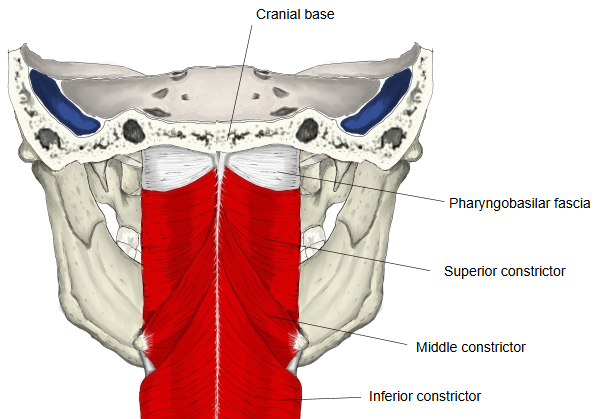
The pharynx has a connective-tissue base layer: a thin but strong membrane, closely bound to the submucosa and to the muscle layer, that is firmly attached to the base of the skull. Above, it is fixed to the basilar part of the occipital bone around the pharyngeal tubercle, to the petrous part of the temporal bone and to the medial pterygoid plate; lower down it becomes thin and blends with the submucosa.
The pharyngobasilar fascia is the part of this membrane between the base of the skull and the upper border of the superior pharyngeal constrictor, where it is not covered by muscle and alone forms the wall of the nasopharynx. The auditory tube and levator veli palatini reach the pharynx through this upper gap.
· Sources differ in how they use the name: some give it to the whole fibrous layer of the pharyngeal wall, others only to the exposed upper part above the superior constrictor.
Related terms
References and sources
- Further reading: Pharyngobasilar fascia, Wikipedia.
- Further reading: Pharynx, Wikipedia.
- Federative International Programme for Anatomical Terminology (FIPAT). Terminologia Anatomica, 2nd ed. (TA2), 2019.