Cranial base (Latin: basis cranii)
Also called the base of skull or the skull base
The floor of the neurocranium, the part of the skull that holds the brain. It is divided into two surfaces: the inner internal cranial base and the outer external cranial base.
base
- Internal cranial base : the upper surface, facing the brain; it steps down in three cranial fossae: anterior, middle and posterior.
- External cranial base : the under surface, seen when the skull is turned over; usually described in anterior, middle and posterior parts.
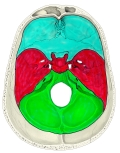 Internal cranial base
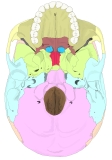 External cranial base
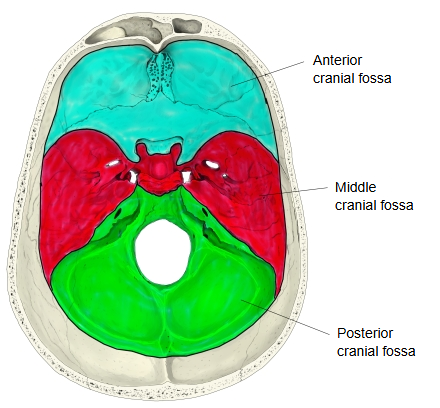
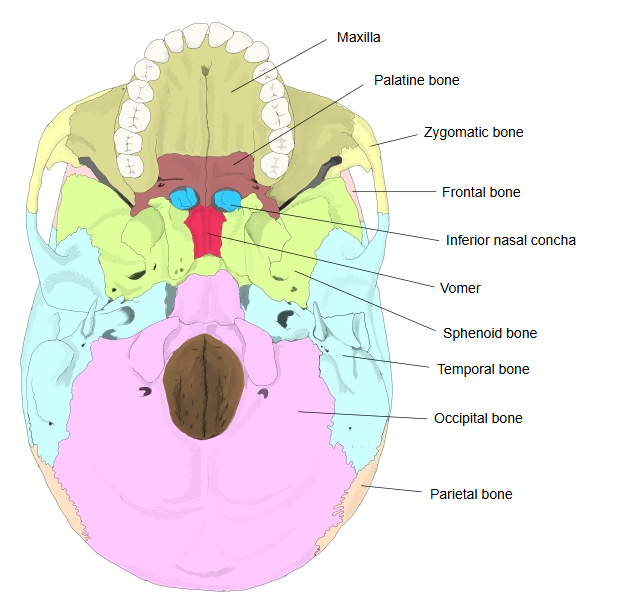
Above the cranial base is the calvaria, the vault of the skull; below and in front it joins the facial skeleton. It is formed by the frontal, ethmoid, sphenoid, temporal and occipital bones. Many foramina pass through it, carrying the cranial nerves, the spinal cord and the vessels of the brain; the largest is the foramen magnum. Most of it forms in cartilage, unlike the calvaria, which forms in membrane.
Sources differ on where the cranial base ends at the back. In regional (topographical) anatomy the nuchal area behind the foramen magnum, on the nuchal plane of the occipital squama, is often included: it reaches from the back edge of the foramen magnum out to the back edge of the mastoid processes and up to the superior nuchal lines. In the morphological sense used by Rauber-Kopsch, however, the cranial base ends behind at the front edge of the foramen magnum. Most current texts (such as Gray's) take the whole region around the foramen magnum, back to the superior nuchal lines, as part of the external cranial base.
Related terms
- Cranial fossa
- Cranial cavity
- Cranial synchondroses
- Basilar part of occipital bone
- Internal cranial base
- External cranial base
- Neurocranium
- Calvaria
- Anterior cranial fossa
- Middle cranial fossa
- Posterior cranial fossa
References and sources
- Further reading: Base of skull, Wikipedia.
- Federative International Programme for Anatomical Terminology (FIPAT). Terminologia Anatomica, 2nd ed. (TA2), 2019.