Posterior atlanto-axial membrane (Latin: membrana atlantoaxialis posterior)
Also called: posterior atlantoaxial ligament
A membrane stretched between the back of the posterior arch of the atlas and the back of the vertebral arch of the axis.
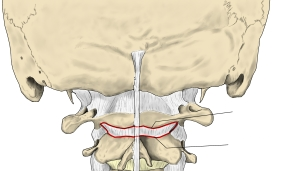 Atlas and axis (posterior view)
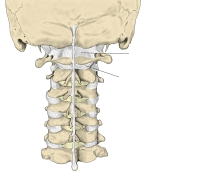 Membranes of the upper neck (posterior view)
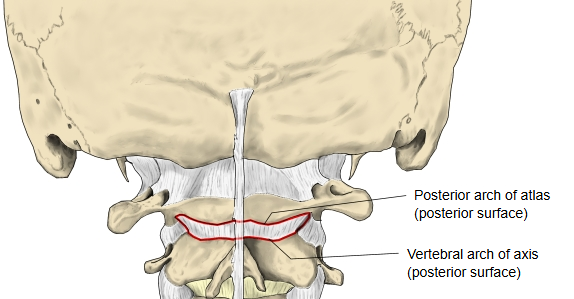
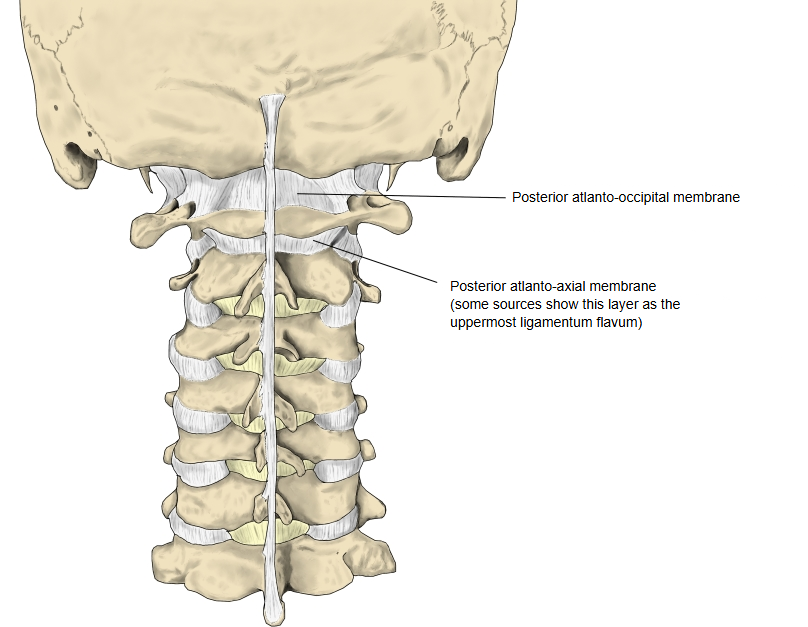
It attaches above to the lower border of the posterior arch of the atlas and below to the upper borders of the laminae of the axis. It lies in the position of the ligamenta flava of the lower vertebrae and continues their line upwards; above the atlas the same layer continues as the posterior atlanto-occipital membrane. It lies deep to the suboccipital muscles; the obliquus capitis inferior lies behind it on each side. Sources differ: some texts and atlases do not name it separately and treat it as the uppermost ligamentum flavum; others describe it as thinner and less elastic than a true ligamentum flavum.
Reference websites
[Wikipedia]
· Atlanto-axial joint, Wikipedia.
[Websites with illustrations]
· Median section through the occipital bone and the first three cervical vertebrae (Gray's Anatomy, fig. 308) (Wikimedia Commons)

Related terms
References and sources
- Further reading: Atlanto-axial joint, Wikipedia.
- Federative International Programme for Anatomical Terminology (FIPAT). Terminologia Anatomica, 2nd ed. (TA2), 2019.