Lamina of vertebral arch (Latin: lamina arcus vertebrae)
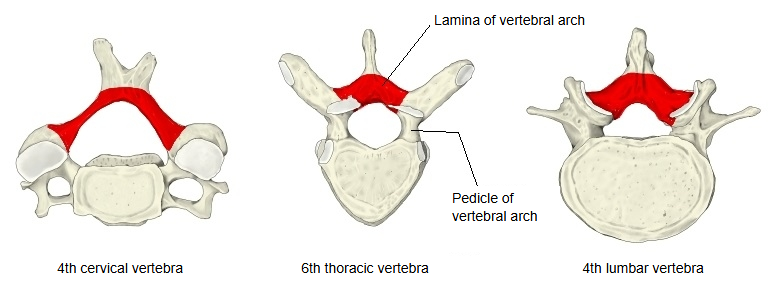
· The atlas (first cervical vertebra) has no typical laminae; its posterior arch takes their place.
· The laminae form the back wall of the vertebral foramen.
 Laminae of C4, T6 and L4
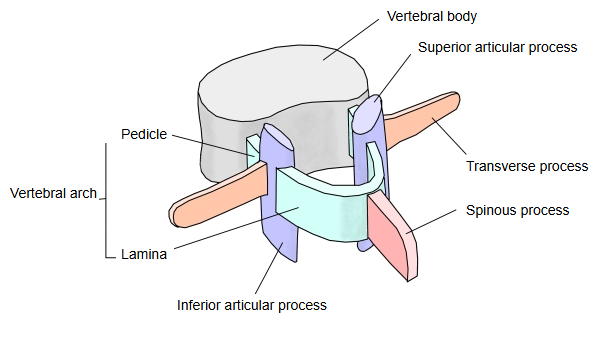
The basic parts of a vertebra are as follows.
structure
of a
vertebra
- Vertebral body : the cylindrical front part, joined to the vertebrae above and below by intervertebral discs.
- Vertebral arch
- Lamina : the flat back part of the arch.
- Pedicle : the short root joining the arch to the body.
- Processes
- Spinous process : the long process pointing backwards.
- Transverse process : the processes to the left and right sides (in the lumbar vertebrae: the costal process).
- Superior and inferior articular processes : processes going up and down from the arch.
Each lamina is a flat, bent plate of bone between the transverse process and the spinous process. It runs backwards and inwards from the end of the pedicle, and the two laminae meet in the midline, where the spinous process arises.
Together the laminae form the back wall of the vertebral foramen, and so of the vertebral canal. The laminae of neighbouring vertebrae are joined by the ligamenta flava. In the thoracic vertebrae the laminae are broad and overlap like roof tiles; in the lumbar vertebrae they are short and thick. Removing part of the laminae (laminectomy) is a common way of opening the vertebral canal in spinal surgery.
Related terms
- Vertebral arch
- Vertebral foramen
- Spinous process
- Transverse process
- Vertebral canal
- Vertebral body
- Ligamenta flava
- Posterior arch of atlas
- Thoracic vertebrae
References and sources
- Further reading: Vertebra, Wikipedia.
- Further reading: Laminectomy, Wikipedia.
- Federative International Programme for Anatomical Terminology (FIPAT). Terminologia Anatomica, 2nd ed. (TA2), 2019.