Retromolar triangle (Latin: trigonum retromolare)
Also called the retromolar fossa or the retromolar area
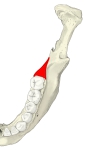 Retromolar triangle
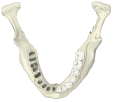 Mandible (from above)
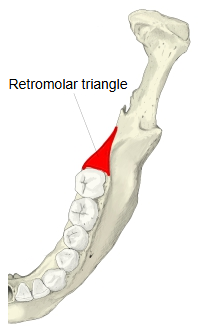
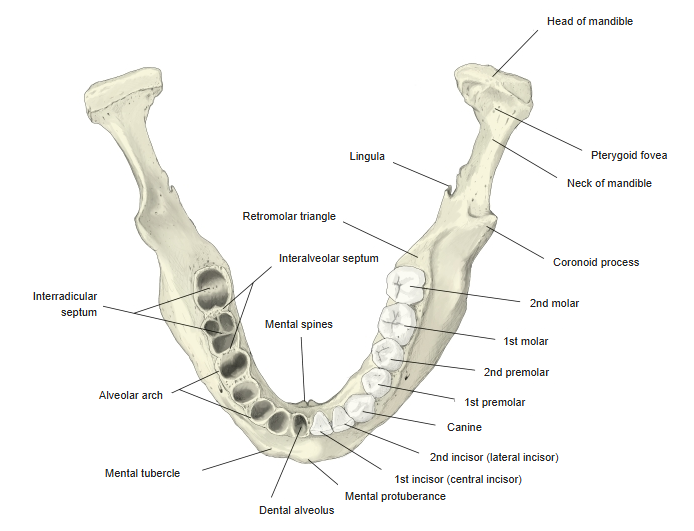
Anatomy references describe it as follows.
The retromolar triangle (also called the retromolar fossa or retromolar area) is a small triangular area at the back of the body of the mandible, between the last molar (usually the third molar; the second when the third is missing) and the front border of the ramus, where that border meets the alveolar margin. Its base lies behind the last molar and its apex points upwards and backwards towards the ramus. The lower end of the pterygomandibular raphe, which runs down from the hamulus of the medial pterygoid plate, is attached near it, and fibres of the buccinator arise close by. It is a landmark in dentistry, for example when giving an inferior alveolar nerve block or removing a lower third molar.
Reference websites
[Wikipedia]
· Retromolar space, Wikipedia.
[Websites with illustrations]
· The mandible (TeachMeAnatomy)
· Mandible (Kenhub)
Related terms
References and sources
- Further reading: Retromolar space, Wikipedia.
- Federative International Programme for Anatomical Terminology (FIPAT). Terminologia Anatomica, 2nd ed. (TA2), 2019.