Sacral hiatus (Latin: hiatus sacralis)
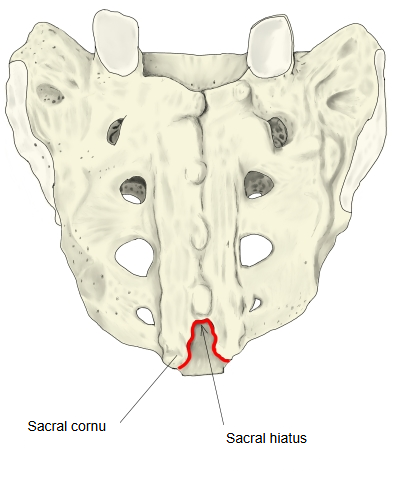
· It forms because the laminae and spinous process of the fifth sacral vertebra (often also the fourth) fail to meet in the midline.
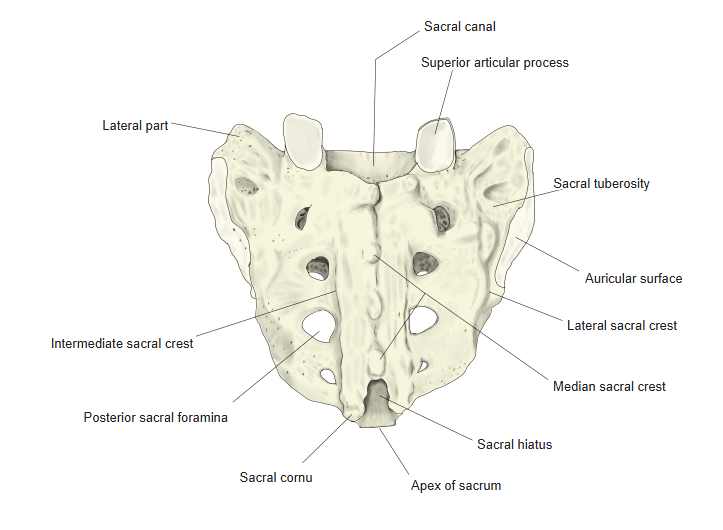
· It lies below the end of the median sacral crest and is usually an inverted U or V shape, bounded on each side by a sacral cornu, which joins the coccygeal cornu below.
· The fifth sacral and coccygeal nerves and the filum terminale pass out through it. In life it is closed over by the superficial dorsal sacrococcygeal ligament.
· The hiatus is the entry point for a caudal epidural block; the sacral cornua on either side are the landmarks used to find it.
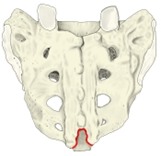 Sacral hiatus (posterior)
 Sacrum (posterior)
Reference websites
[Wikipedia]
· Sacral hiatus, Wikipedia.
· Caudal epidural block, Wikipedia.
[Websites with illustrations]
· Sacrum, dorsal surface (Gray's Anatomy, fig. 96) (Wikimedia Commons)

Where it is found
Related terms
References and sources
- Further reading: Sacral hiatus, Wikipedia.
- Further reading: Caudal epidural block, Wikipedia.
- Federative International Programme for Anatomical Terminology (FIPAT). Terminologia Anatomica, 2nd ed. (TA2), 2019.