Intraperitoneal organs
Overview
· Although they are wrapped in peritoneum, they are not inside the peritoneal cavity itself, which is only the thin space between the visceral and parietal layers. Most are attached to the wall by a mesentery or a peritoneal ligament that carries their vessels and nerves, so many of them can move.
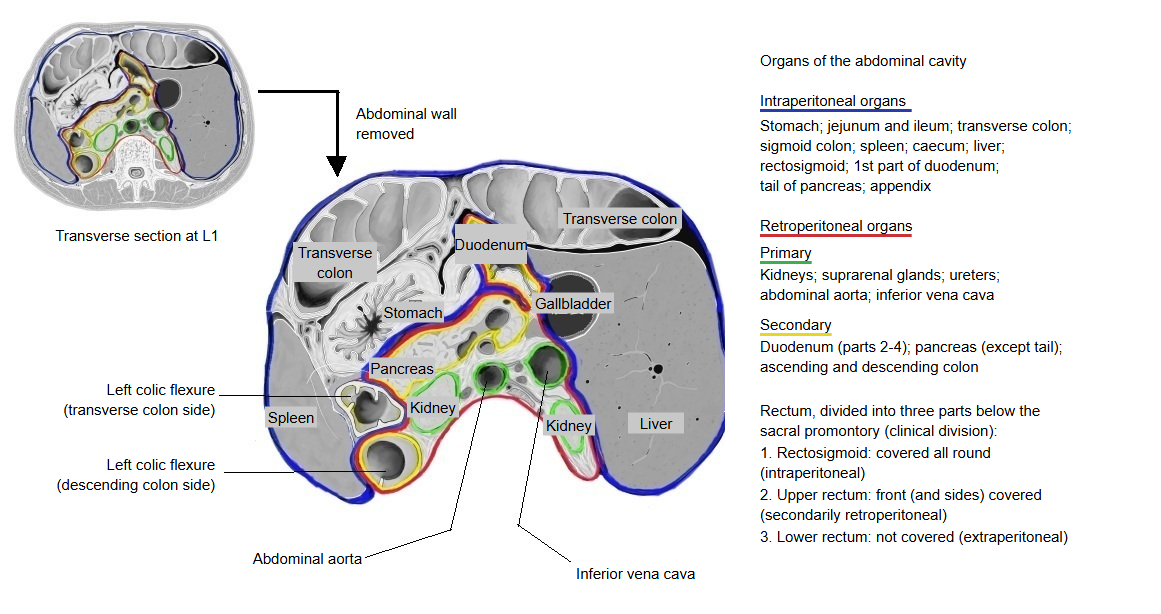
The abdominal organs are divided, as below, into those lying in the abdominal cavity proper and those lying in the retroperitoneum.
fication of
abdominal
organs
- Intraperitoneal organs : lie in the abdominal cavity, covered almost all round by the visceral peritoneum (serosa); joined to the abdominal wall by a mesentery or a peritoneal fold (ligament). Examples: stomach, small intestine, transverse colon, sigmoid colon, liver, spleen.
- Retroperitoneal organs
- Primary : lie in the retroperitoneum (the space behind the abdominal cavity) from the start of development; firmly fixed. Examples: kidneys, suprarenal glands, ureters, abdominal aorta, inferior vena cava.
- Secondary : lie in the abdominal cavity at first and become fixed to the posterior abdominal wall during development. Examples: duodenum (parts 2–4), pancreas (except the tail), ascending colon, descending colon, caecum (in some cases).
· Note: "abdominal organs" and "intraperitoneal organs" are both widely used, but neither is an official heading of Terminologia Anatomica (TA); they are descriptive groupings, and some sources treat them as the same. The opposite groups are the retroperitoneal and subperitoneal organs, together called extraperitoneal organs.
List
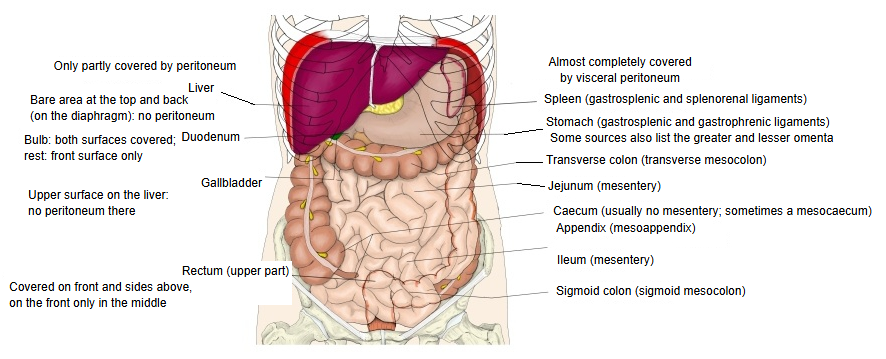
① hollow (tube-like) organs wrapped almost all round by the visceral peritoneum (the main group);
② solid organs of which only a part is covered by the visceral peritoneum.
| Organ | Class | Peritoneal covering | Notes | |
|---|---|---|---|---|
| 1 | Stomach | Intraperitoneal | almost all round | Gastrosplenic ligament, gastrophrenic ligament (some sources also list the greater and lesser omenta) |
| 2 | Jejunum | almost all round | The mesentery | |
| 3 | Ileum | almost all round | The mesentery | |
| 4 | Caecum | almost all round | Usually no mesentery; sometimes a mesocaecum | |
| 5 | Appendix | almost all round | Mesoappendix | |
| 6 | Transverse colon | almost all round | Transverse mesocolon | |
| 7 | Sigmoid colon | almost all round | Sigmoid mesocolon | |
| 8 | Spleen | almost all round | Gastrosplenic ligament, splenorenal ligament | |
| 9 | Liver | Intraperitoneal (exceptional type) | most of the surface | Has a bare area (upper posterior part) lying directly on the diaphragm |
| 10 | Gallbladder | partial | The upper surface (gallbladder bed on the liver) has no peritoneum | |
| 11 | Duodenum (first part: bulb) | Partly intraperitoneal | front and back | Most of it (parts 2–4) is a secondarily retroperitoneal organ |
| 12 | Rectum (upper and middle parts) | partial | The upper part is covered on the front and sides and the middle part on the front only; the rest lies below the peritoneum (subperitoneal). |
· Sources differ for a few organs, such as the caecum, the tail of the pancreas and the parts of the rectum, and in whether the gallbladder and the first part of the duodenum are counted as intraperitoneal.
Related terms
References and sources
- Further reading: Peritoneum, Wikipedia.
- Further reading: Retroperitoneal space, Wikipedia.
- Federative International Programme for Anatomical Terminology (FIPAT). Terminologia Anatomica, 2nd ed. (TA2), 2019.