Sublingual fossa (Latin: fovea sublingualis)
Also called the sublingual fovea
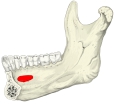 Mandible (medial surface)
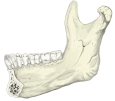 Mandible (medial surface, labelled)
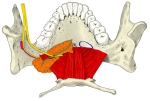 Floor of the mouth (from above)
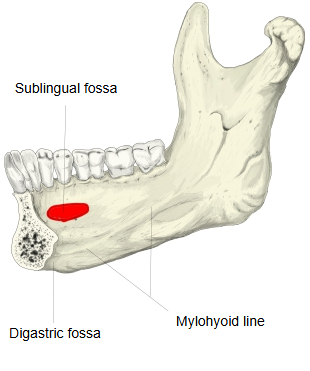
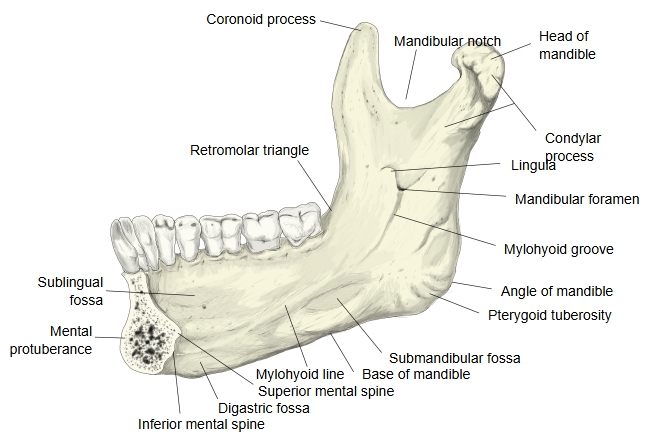
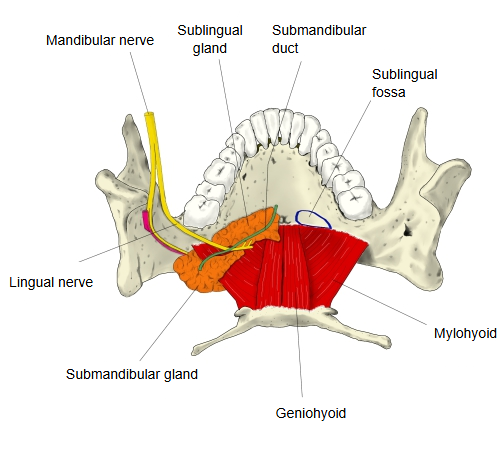
The sublingual fossa is a shallow, smooth hollow on each side of the front of the body of the mandible, near the midline, beside the mental spines (geniohyoid spine) and above the front part of the mylohyoid line. It is roughly triangular or oval and is best seen on a dry bone. The sublingual gland rests against it, above the mylohyoid muscle and under the mucosa of the floor of the mouth. Below the mylohyoid line, further back, is a second hollow, the submandibular fossa, for the submandibular gland.
Reference websites
[Wikipedia]
· Mandible, Wikipedia.
· Sublingual gland, Wikipedia.
[Websites with illustrations]
· The mandible (TeachMeAnatomy)
· Mandible, inner surface (Gray's Anatomy) (Wikimedia Commons)

Related terms
- Sublingual ganglion
- Mylohyoid line
- Submandibular fossa
- Body of mandible
- Geniohyoid spine
- Sublingual gland
- Floor of mouth
- Mandible
References and sources
- Further reading: Mandible, Wikipedia.
- Further reading: Sublingual gland, Wikipedia.
- Federative International Programme for Anatomical Terminology (FIPAT). Terminologia Anatomica, 2nd ed. (TA2), 2019.