Lingula (Latin: lingula pulmonis sinistri)
Also called Lingula of left lung
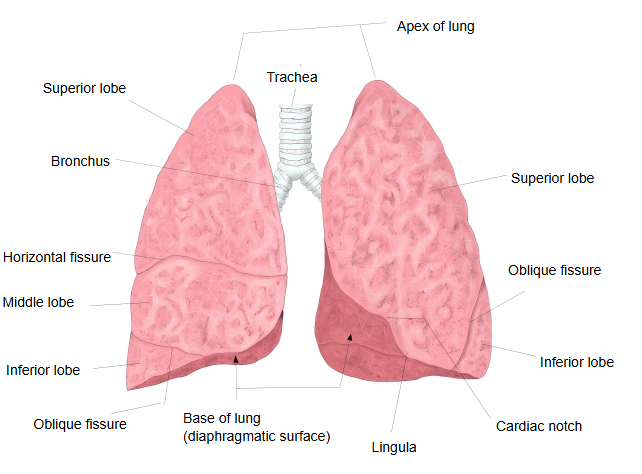
Unlike the right lung, the left lung has no middle lobe. Instead, the name lingula (Latin for 'little tongue') is given to a projection of the superior lobe of the left lung that curves forward and medially over the heart at the lower end of the anterior border; it is generally regarded as the counterpart of the right middle lobe. It has two bronchopulmonary segments, the superior and inferior lingular segments. It is thought that the lingula may be what remains of a middle lobe lost in the course of evolution.
The lingula is supplied by the lingular bronchus, a branch of the superior lobar bronchus (see bronchi). It lies in front of the lower part of the oblique fissure, which separates it from the inferior lobe. Other structures are also called lingula, for example the lingula of the mandible and the lingula of the cerebellum; on its own in the chest, the word means this part of the left lung.
Reference websites
[Wikipedia]
· Lung, Wikipedia.
· Bronchopulmonary segment, Wikipedia.
· Lingula of left lung, IMAIOS e-Anatomy.
[Websites with illustrations]
· Lingula of lung (Innerbody)

· Left lung with the lingula (Medicoapps)

Where it is found
Related terms
References and sources
- Further reading: Lung, Wikipedia.
- Further reading: Bronchopulmonary segment, Wikipedia.
- Federative International Programme for Anatomical Terminology (FIPAT). Terminologia Anatomica, 2nd ed. (TA2), 2019.