Suspensory ligaments of breast (Cooper's ligaments)
· Their three-dimensional arrangement inside the breast has been studied with imaging methods such as transmission diffraction tomography.
· Intact ligaments help hold the breast up on the upper chest wall, towards the clavicle, through the deep fascia.
· They are not the same as the pectineal ligament of the groin (along the pecten pubis), which carries the same eponym and is sometimes called Cooper's ligament. The transverse (oblique) band of the ulnar collateral ligament of the elbow is also sometimes called Cooper's ligament.
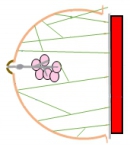 Breast in section (schematic)
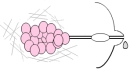 Mammary gland
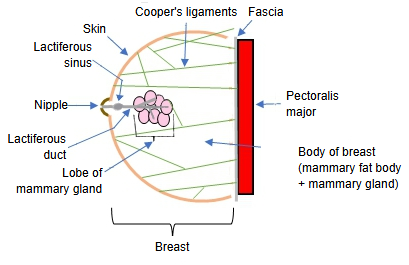
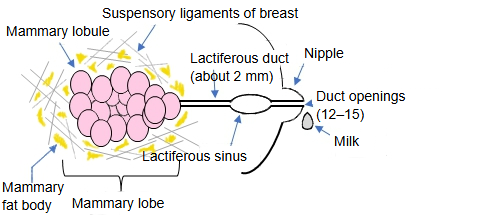
[More detail]
Cooper's ligaments (also called the suspensory ligaments of Cooper, the suspensory ligaments of the breast, or the fibrocollagenous septa) are the connective tissue that keeps the structure of the breast together. They are named after the English surgeon Sir Astley Cooper, who described them in 1840.
Structure
They are fibrous septa that pass from the pectoral fascia between the lobes of the mammary gland and through the surrounding fat to the dermis of the overlying skin, dividing the mammary fat into compartments. Together they support the breast on the chest wall and keep its normal position and shape. The glandular tissue is denser than the fat around it; without this internal support the breast would hang lower under its own weight and lose its normal contour (ptosis, see below).
Clinical significance
Cooper's ligaments explain some skin changes in breast cancer. In inflammatory breast cancer the local lymphatic vessels are blocked and the breast swells; because the skin is tied down by the ligaments, it becomes pitted like the peel of an orange (peau d'orange). A carcinoma that involves the ligaments can also shorten them and pull the skin inwards, causing dimpling.
Breast ptosis (sagging)
Sagging of the breast is often blamed on stretching of Cooper's ligaments, but it has several causes. Genetic factors play a part, and age, the number of pregnancies, breast size before pregnancy, body-mass index, large weight changes and smoking all contribute. During pregnancy and breast-feeding the mammary gland enlarges, stretching the skin and the ligaments; after weaning, hormonal changes make the glandular tissue shrink (involution), so the stretched skin and ligaments no longer fit the smaller gland. Weight gain and loss can stretch the breast tissue and ligaments in the same way. A well-fitting bra supports the breast while it is worn, but there is no good evidence that it prevents ptosis.
Reference websites
[Wikipedia]
· Cooper's ligaments, Wikipedia.
[Websites with illustrations]
· Breast in section with Cooper's ligaments, lobules and ducts (illustration) (thoracickey.com)
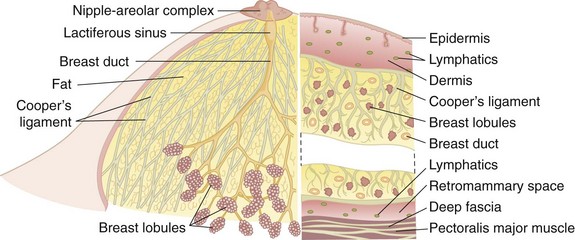
· Breast and chest wall in sagittal section (illustration) (highdefinitionbodycontouring.com)

Related terms
- Breast
- Mammary gland
- Body of breast
- Mammary fat body
- Lobes of mammary gland
- Lactiferous duct
- Lactiferous sinus
- Nipple
- Areola
- Pectoral fascia
- Clavipectoral fascia
- Pectoralis major
- Clavicle
- Dermis
- Connective tissue
- Pectineal ligament
References and sources
- Further reading: Cooper's ligaments, Wikipedia.
- Federative International Programme for Anatomical Terminology (FIPAT). Terminologia Anatomica, 2nd ed. (TA2), 2019 (suspensory ligaments of breast).