Latin: auris externa
Overview
- The outer part of the ear: the auricle and the external acoustic meatus, which ends at the tympanic membrane.
- Collects sound waves and directs them to the tympanic membrane; the shape of the auricle also helps to tell whether a sound comes from in front or behind, above or below.
- The tympanic membrane forms the boundary with the middle ear.
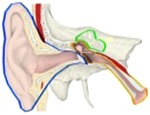
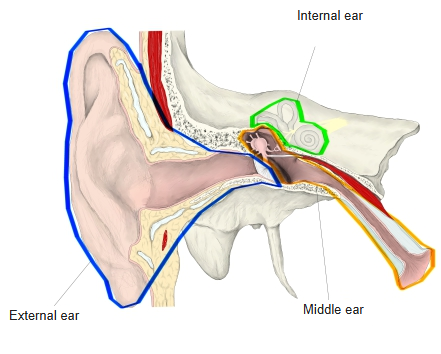
External, middle and internal ear 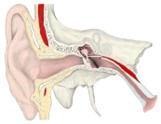
Ear, coronal section
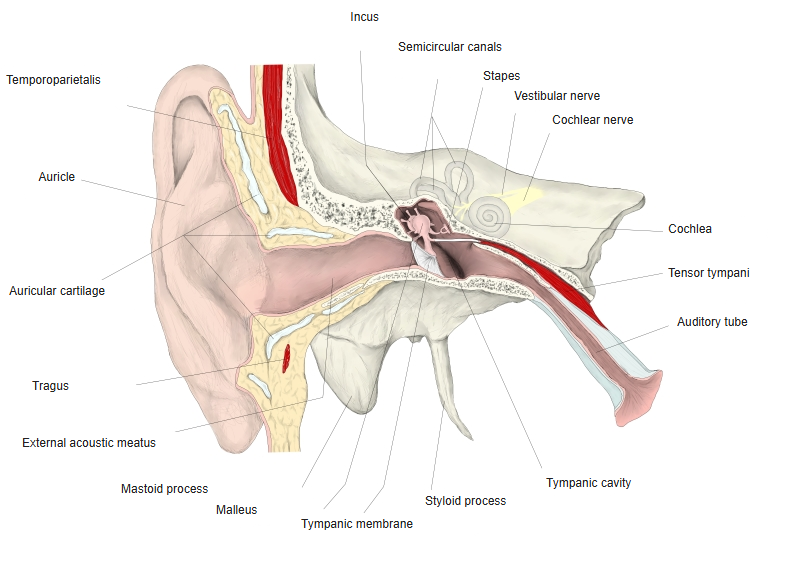
Parts
| Part | Description |
|---|---|
| Auricle | Skin-covered plate of elastic cartilage on the side of the head; only the lobule has no cartilage |
| External acoustic meatus | S-shaped canal, about 2.5 cm long; lateral third cartilaginous, medial two-thirds bony. Its skin has hairs and ceruminous (wax) glands |
| Tympanic membrane | Thin oval membrane at the end of the meatus, set obliquely; vibrates with sound |
- Sensory nerves: great auricular, auriculotemporal and lesser occipital nerves, and the auricular branch of the vagus nerve.
- Arteries: the posterior auricular and superficial temporal arteries (branches of the external carotid artery).
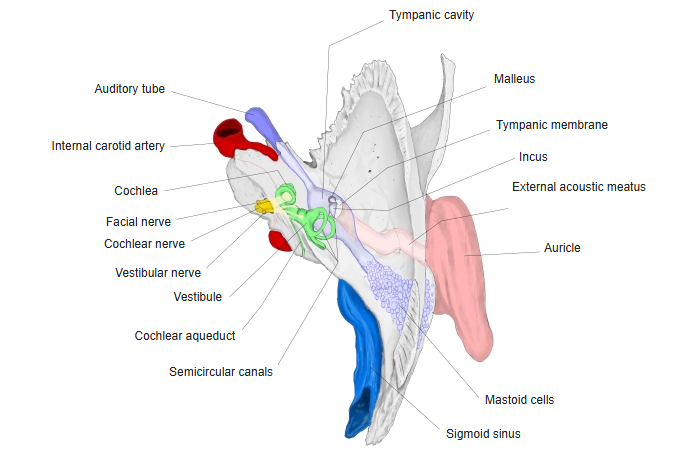
Right ear in the temporal bone (superior view)
References and sources
- Further reading: External ear, Wikipedia.