Latin: membrana tympanica
Overview
- A thin, pearly grey, oval membrane that closes the end of the external acoustic meatus and separates it from the tympanic cavity.
- About 9–10 mm high and 8–9 mm wide, about 0.1 mm thick.
- Set obliquely, facing down, forwards and outwards; its centre is pulled inwards by the handle of the malleus.
- Vibrates with sound and passes the vibration to the auditory ossicles. Glossary entry: tympanic membrane.
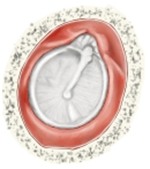
Right tympanic membrane, lateral surface
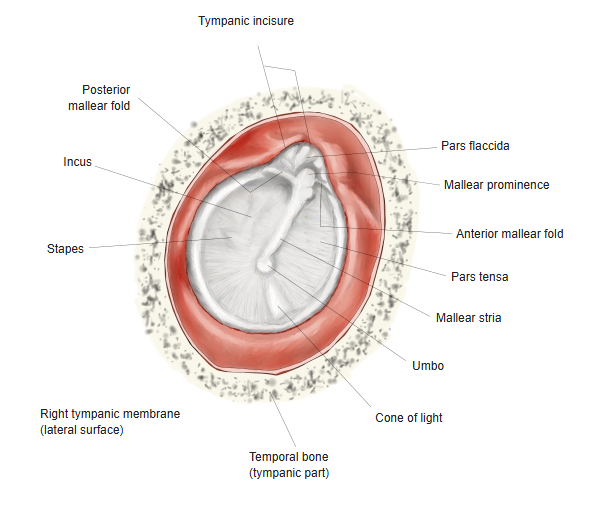
Parts and landmarks
| Feature | Description |
|---|---|
| Pars tensa | Most of the membrane; taut, held in the tympanic sulcus by a fibrocartilaginous ring |
| Pars flaccida | Small, slack upper part above the mallear folds, at the tympanic notch |
| Anterior and posterior mallear folds | Folds running from the lateral process of the malleus to the ends of the tympanic notch; they separate the two parts |
| Mallear prominence | Small bump made by the lateral process of the malleus |
| Mallear stria | Line made by the handle of the malleus, running down and back to the umbo |
| Umbo | Deepest point, at the tip of the handle of the malleus |
| Cone of light | Triangular reflection seen with an otoscope, running down and forward from the umbo |
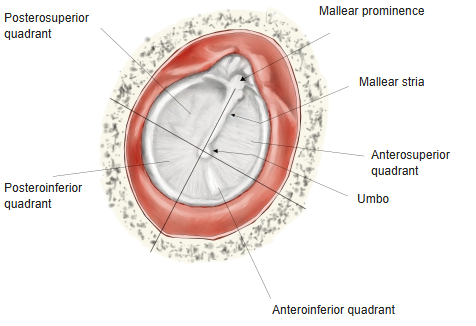
- For clinical description the membrane is divided into four quadrants by a line along the handle of the malleus and a line through the umbo at right angles to it.
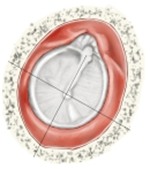
Quadrants of the tympanic membrane
Layers, blood supply and nerves
- Three layers: outer skin (continuous with the meatus), middle fibrous layer (radial and circular fibres; missing in the pars flaccida) and inner mucous membrane (continuous with the tympanic cavity).
- Blood supply from the deep auricular artery on the outer surface and from branches to the tympanic cavity (anterior tympanic and stylomastoid arteries) on the inner surface.
- Outer surface: auriculotemporal nerve and auricular branch of the vagus nerve; inner surface: tympanic nerve (glossopharyngeal nerve).
References and sources
- Further reading: Tympanic membrane, Wikipedia.