Latin: mesenterium
Overview
- A double fold of peritoneum attaching the jejunum and ileum to the posterior abdominal wall.
- Between its two layers run the blood vessels, lymphatics, lymph nodes and nerves of the small intestine, embedded in fat.
- Fan-shaped: a short root of about 15 cm, but an intestinal border several metres long that follows the coils of the intestine.
- In a wider sense, "mesentery" also includes the mesocolons and the mesoappendix; it is now often described as one continuous structure.
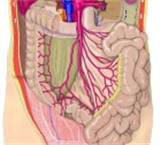
Mesentery of the small intestine 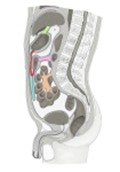
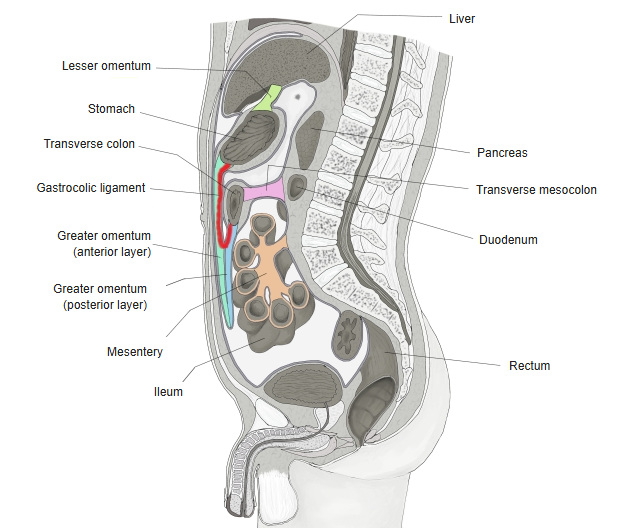
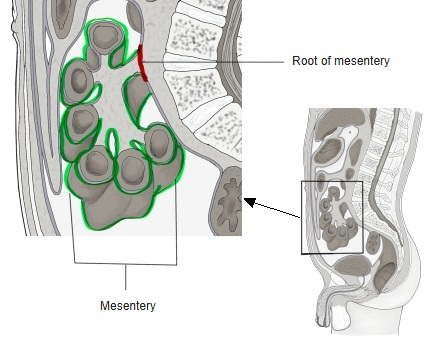
Peritoneum in a median section
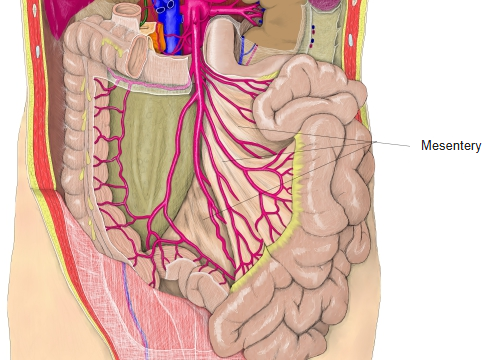
Root of the mesentery
- Attached to the posterior abdominal wall along an oblique line about 15 cm long.
- Runs from the duodenojejunal flexure (left side of L2) to the ileocaecal junction near the right sacroiliac joint.
- Crosses, in order, the third part of the duodenum, the abdominal aorta, the inferior vena cava, the right ureter and right psoas major.
- Distance from the root to the intestine is about 20 cm.
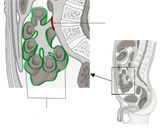
Root of the mesentery 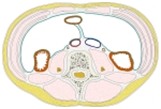
Transverse section at the level of L4
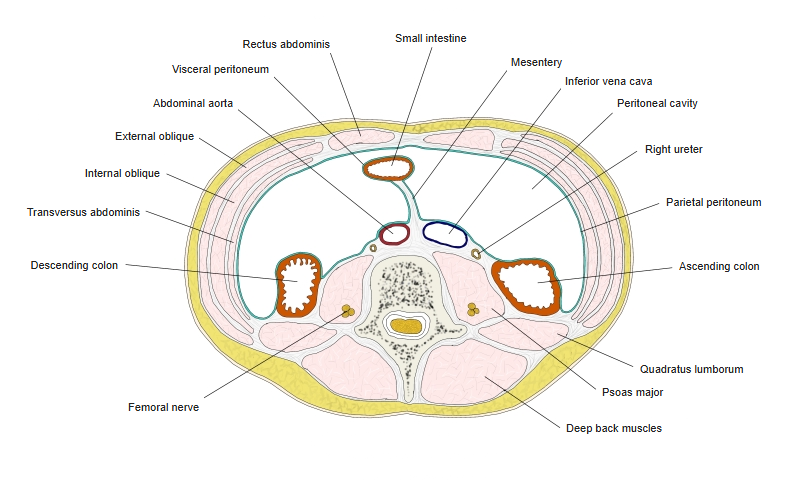
Contents
| Structure | Details |
|---|---|
| Arteries | Jejunal and ileal branches, ileocolic artery and others from the superior mesenteric artery |
| Veins | Tributaries of the superior mesenteric vein, which joins the splenic vein to form the hepatic portal vein |
| Lymphatics | Lacteals and about 100–200 mesenteric lymph nodes, draining toward the superior mesenteric nodes and the cisterna chyli |
| Nerves | Sympathetic and parasympathetic (vagus) fibres from the superior mesenteric plexus; visceral pain fibres |
| Fat | Variable amount, increasing toward the root |
Other mesenteries
- Transverse mesocolon: attaches the transverse colon; its root crosses the pancreas.
- Sigmoid mesocolon: inverted-V attachment in the left iliac fossa and pelvis.
- Mesoappendix: small triangular fold for the appendix.
- Ascending and descending colon usually have no mesocolon in the adult (they are secondarily retroperitoneal).
References and sources
- Further reading: Mesentery, Wikipedia.