Latin: intestinum tenue
Overview
- The longest part of the digestive tract, between the stomach (pylorus) and the large intestine (ileocecal junction).
- Main site of digestion and absorption of nutrients.
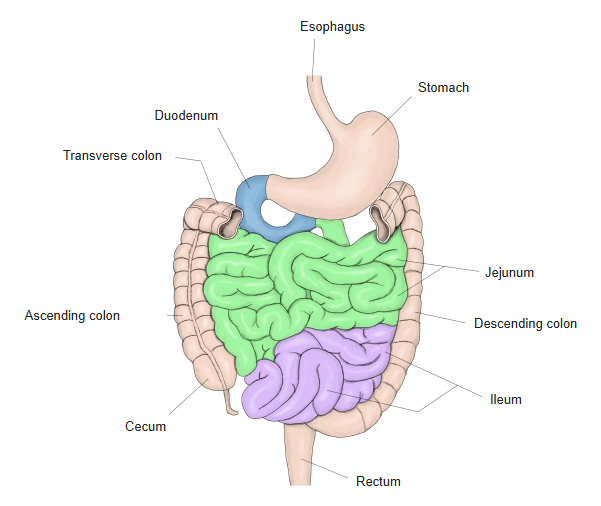
- Three parts: duodenum, jejunum and ileum.
- Total length about 6–7 m after death; much shorter in the living body because of muscle tone.
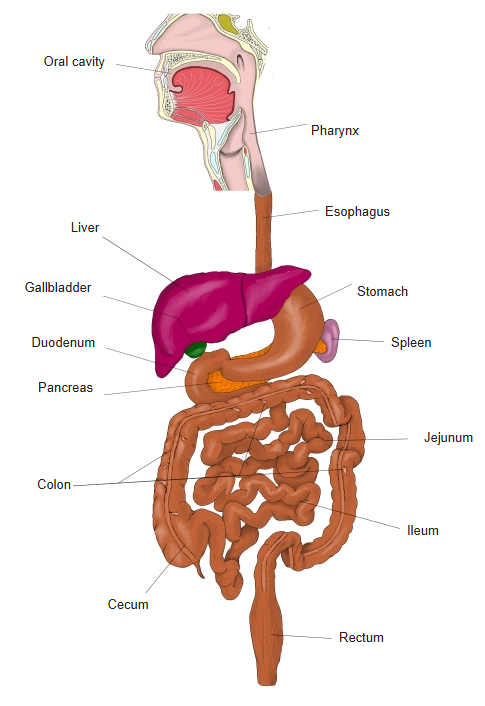
Small intestine in the abdomen 
Organs of the digestive system
Parts
| Part | Length | Features |
|---|---|---|
| Duodenum | About 25–30 cm | C-shaped, mostly retroperitoneal; receives bile and pancreatic juice |
| Jejunum | About 2/5 of the rest | Wider, thicker wall, many high circular folds; main site of absorption |
| Ileum | About 3/5 of the rest | Narrower and thinner; Peyer's patches; ends at the ileocecal valve |
- The jejunum and ileum hang on the mesentery and are freely mobile; there is no sharp boundary between them.
- Diameter decreases from about 3–3.5 cm (upper jejunum) to about 2–2.5 cm (terminal ileum).
References and sources
- Further reading: Small intestine, Wikipedia.