Serous gland (Latin: glandula serosa)
glands
- Among the salivary glands : parotid gland (serous), submandibular gland (mixed), sublingual gland (mixed).
- Others : lacrimal gland (tears), exocrine part of the pancreas (pancreatic juice) and others.
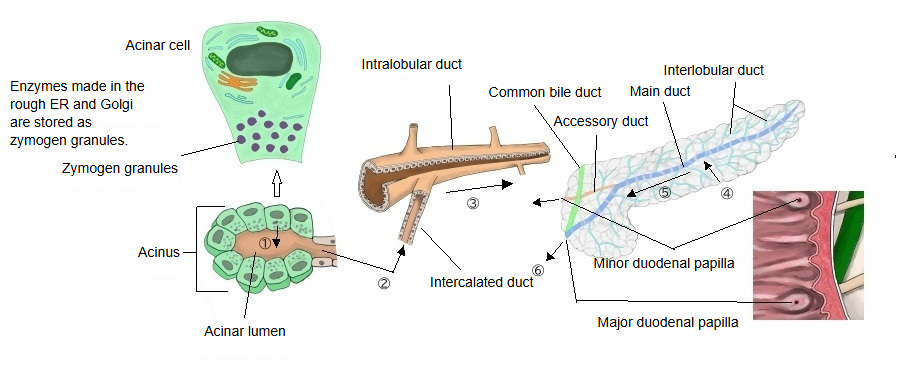
From the acinus the secretion passes into the intercalated ducts, then the intralobular (striated) ducts, then the larger interlobular and excretory ducts. In the pancreas, pale centroacinar cells (the start of the intercalated duct) lie inside the acini.
Serous cells are pyramidal, with a round nucleus near the base, strongly staining (basophilic) cytoplasm rich in rough endoplasmic reticulum, and zymogen granules at the apex. The granules hold the enzymes made in the rough ER and packed in the Golgi apparatus; they are released into the lumen by exocytosis.
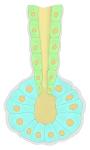 Exocrine gland (diagram)
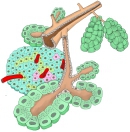 Acini and islet (pancreas)
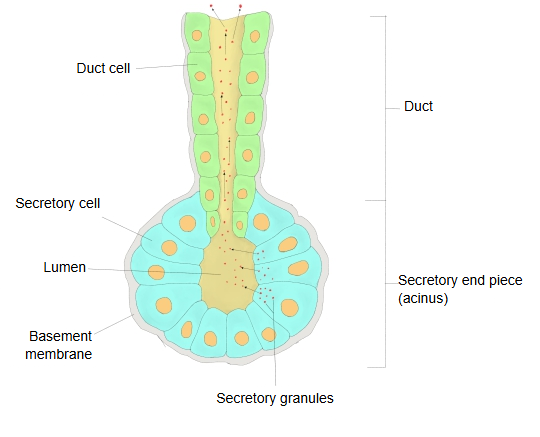
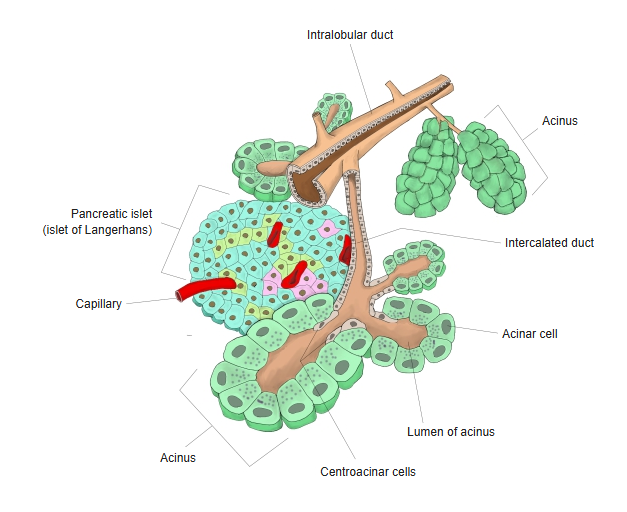
The figure below shows in simple form how pancreatic juice is secreted and carried in the pancreas.
The figure below shows the salivary glands in simple form.
glands
- Major salivary glands : lie at a distance from the oral mucosa and release saliva through ducts.
- Parotid gland : below and in front of the external acoustic meatus; a flattened, irregular triangle; the largest salivary gland; serous. The parotid duct opens into the oral vestibule.
- Submandibular gland : in the submandibular triangle; flattened oval; mixed (mainly serous). The submandibular duct opens on the sublingual caruncle.
- Sublingual gland : in the floor of the mouth; long from front to back and flattened from side to side; the smallest major salivary gland; mixed (mainly mucous).
- Minor salivary glands : lie in the mucosa and release saliva into the oral cavity directly or through short ducts.
- Labial glands : in the mucosa of the lips; mixed; few at the corners of the mouth, some also within the muscle layer.
- Buccal glands : in the mucosa of the cheeks; mixed; some also lie outside the buccinator.
- Molar glands : at the back of the cheek, between the masseter and the buccinator; mixed; open opposite the last upper molar teeth.
- Palatine glands : in groups in the hard palate and scattered in the soft palate; mucous.
- Lingual glands : three kinds by position:
- Anterior lingual glands : on both sides of the underside of the tip of the tongue; mixed; their ducts open on the underside of the tongue beside the frenulum.
- Posterior lingual glands : at the root and the back of the sides of the tongue; mucous.
- Von Ebner's glands : open into the trenches around the vallate papillae and between the foliate papillae; serous.
The figure below shows the secretory glands in simple form.
- Exocrine glands
- Onto the body surface : sweat glands (eccrine and apocrine), sebaceous glands, mammary glands = the skin glands.
- Into the digestive tract : salivary glands (serous or mixed), pancreas (serous), liver, gastric glands, duodenal glands.
- Others : nasal glands, lacrimal glands (serous).
- Endocrine glands
- Brain : pituitary gland, pineal gland.
- Neck : thyroid gland, parathyroid glands.
- Internal organs : adrenal glands, pancreas (islets).
- Reproductive organs : gonads: ovaries (with the corpus luteum) and testes; in pregnancy also the placenta.
In short:
A serous gland contains serous acini, groups of serous cells that secrete a fluid roughly isotonic with blood plasma and carrying enzymes such as alpha-amylase.
Further points:
Serous glands give a protein-rich secretion. Examples are the exocrine pancreas, the lacrimal gland, the parotid gland and the serous glands of the tongue (von Ebner's glands); the chief cells of the gastric glands make a similar enzyme-rich secretion.
Among the salivary glands, the parotid is almost purely serous in adults. Glands that contain both serous and mucous cells are called mixed (seromucous) glands: the submandibular gland is mixed but mainly serous, the sublingual gland mixed but mainly mucous. In mixed glands serous cells often form caps on the ends of mucous tubules, called serous demilunes; many now regard these partly as an artefact of tissue fixation. Some texts list the sublingual gland among the serous glands, but most describe it as mixed with a large mucous part.
Reference websites
[Wikipedia]
· Serous gland, Wikipedia.
· Salivary gland, Wikipedia.
· Serous demilune, Wikipedia.
[Websites with illustrations]
· Salivary glands (Kenhub)
· The salivary glands (TeachMeAnatomy)
· Salivary gland (histology) (The Human Protein Atlas)
Where it is found
Related terms
- Parotid gland
- Submandibular gland
- Sublingual gland
- Salivary glands
- Acinar cells
- Lingual glands
- Palatine glands
References and sources
- Further reading: Serous gland, Wikipedia.
- Further reading: Salivary gland, Wikipedia.
- Federative International Programme for Anatomical Terminology (FIPAT). Terminologia Anatomica, 2nd ed. (TA2), 2019.