Terminal bronchiole (Latin: bronchiolus terminalis)
Also called the plural terminal bronchioles
It has the following features.
· The lining is a single layer of ciliated cuboidal to low columnar cells, made up of ciliated cells and secretory cells, the club cells (formerly Clara cells). Club cells secrete protective proteins, help break down inhaled toxins and can renew the lining. Goblet cells are absent.
· No pieces of cartilage are found in the wall, and there are no glands.
· A thin layer of smooth muscle encircles the wall.
· It is about 0.5 mm or less across and has no alveoli in its wall: it only carries air.
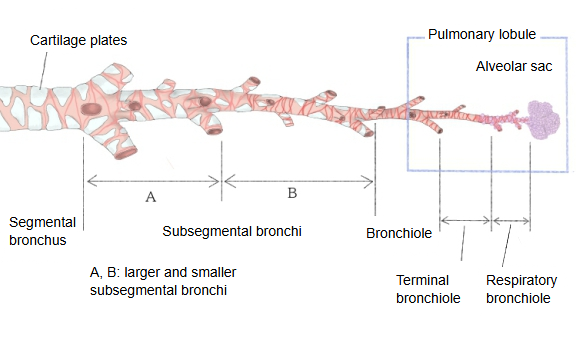
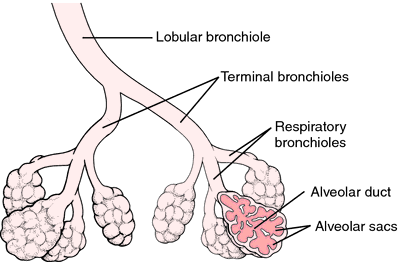
· Each terminal bronchiole divides into two or more respiratory bronchioles. The lung tissue supplied by one terminal bronchiole is a pulmonary acinus, the basic unit of gas exchange.
· It marks the end of the conducting zone: the air in all airways down to this level does not take part in gas exchange (the anatomical dead space). Some older texts use the name loosely for the respiratory bronchioles that follow; here it means the last bronchiole without alveoli.
From the bronchi to the alveoli
Reference websites
[Wikipedia]
· Bronchiole, Wikipedia.
· Club cell, Wikipedia.
[Websites with illustrations]
· Terminal bronchiole (IMAIOS e-Anatomy)
· Bronchioles and alveoli (illustration) (The Free Dictionary (Medical))
· Terminal and respiratory bronchioles (DifferenceBetween.com)

Where it is found
Related terms
References and sources
- Further reading: Bronchiole, Wikipedia.
- Further reading: Club cell, Wikipedia.
- Federative International Programme for Anatomical Terminology (FIPAT). Terminologia Anatomica, 2nd ed. (TA2), 2019.