Respiratory bronchiole (Latin: bronchiolus respiratorius)
Also called the plural respiratory bronchioles
· It has scattered alveoli opening from its wall, so it both carries air and takes part in gas exchange. It marks the start of the respiratory zone; because it still conducts air, it is often called the transitional zone.
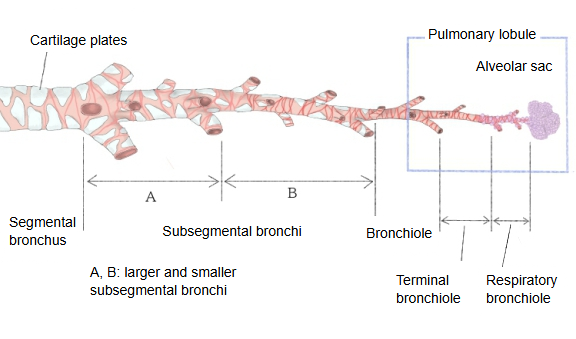
· Each terminal bronchiole divides into two or more respiratory bronchioles, which branch again for about 2–3 generations.
· Alveoli become more numerous along its length. Between them the wall is lined by cuboidal epithelium (ciliated at first, losing its cilia further on) with club cells, over a thin layer of smooth muscle and elastic fibres. Neighbouring alveoli are linked by alveolar pores.
· Each respiratory bronchiole ends by dividing into several alveolar ducts (sources give about 2–11), which lead to alveolar sacs.
· In smokers, centrilobular (centriacinar) emphysema begins around the respiratory bronchioles in the centre of the acinus.
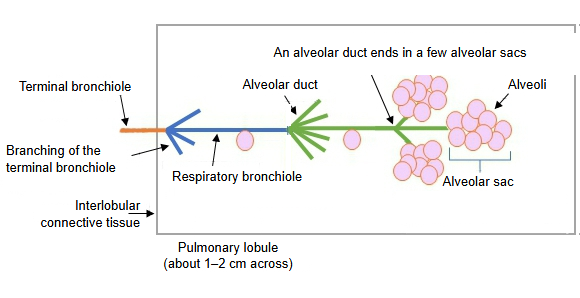
From the bronchi to the alveoli
Reference websites
[Wikipedia]
· Bronchiole, Wikipedia.
· Respiratory tract, Wikipedia.
[Websites with illustrations]
· Bronchioles and alveoli (illustration) (The Free Dictionary (Medical))
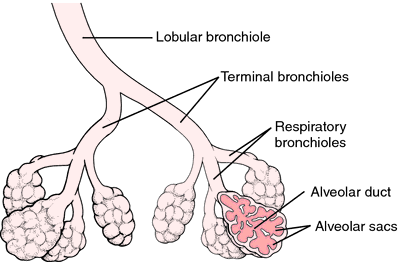
· Terminal and respiratory bronchioles (DifferenceBetween.com)

Where it is found
Related terms
References and sources
- Further reading: Bronchiole, Wikipedia.
- Further reading: Respiratory tract, Wikipedia.
- Federative International Programme for Anatomical Terminology (FIPAT). Terminologia Anatomica, 2nd ed. (TA2), 2019.