Glottis (Latin: glottis)
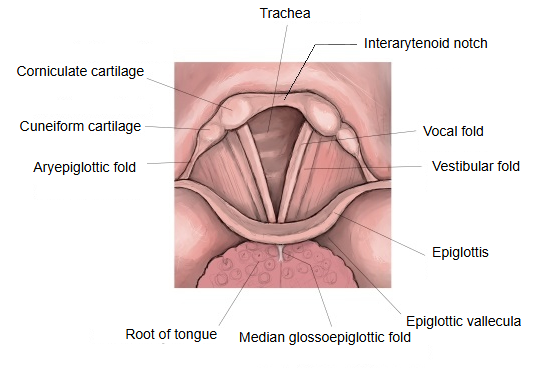
· The term covers the left and right vocal folds and the space between them, the rima glottidis. Sources differ: some use "glottis" for the vocal folds together with the rima glottidis, others for the opening (rima glottidis) alone.
of the
laryngeal
cavity
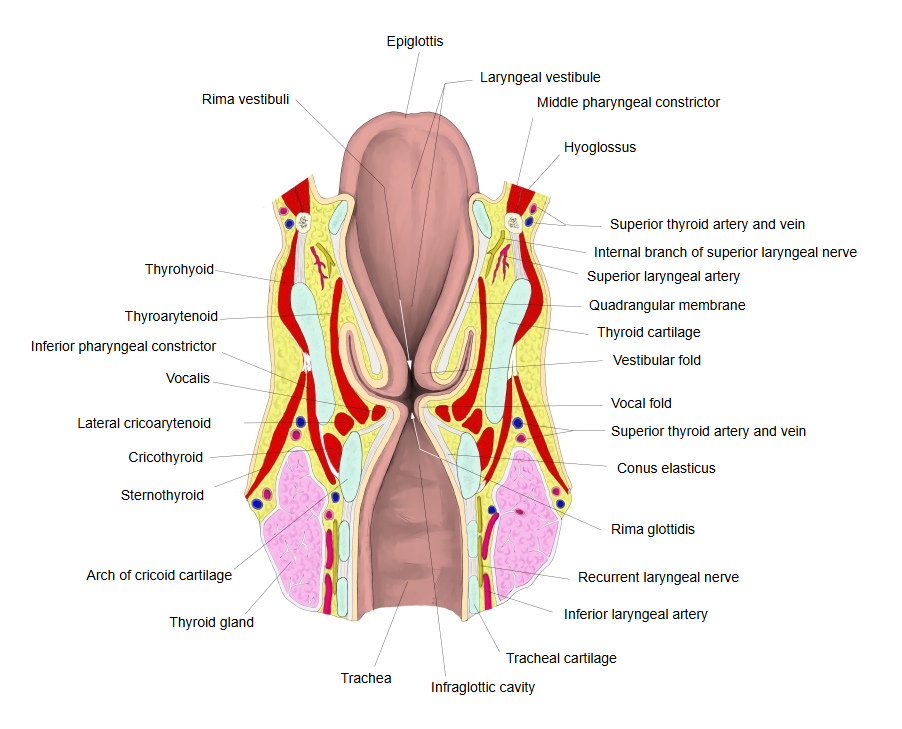
- Laryngeal vestibule : the upper part, from the laryngeal inlet down to the vestibular folds (the supraglottic cavity).
- Intermediate laryngeal cavity : between the vestibular folds and the vocal folds; above, the rima vestibuli, below, the rima glottidis. Contains the glottis.
- Laryngeal ventricle : the recess bulging outwards on each side from the intermediate cavity; its upward extension is the laryngeal saccule.
- Infraglottic cavity : from the rima glottidis down to where the larynx becomes the trachea (at the level of the lower border of the sixth cervical vertebra).
State of the glottis: breathing → open; speaking → closed (but not completely shut)
During breathing the glottis is open to keep the airway clear. During speech it is basically closed,
but not completely: a narrow gap is left in the rima glottidis through which air passes.
Air flowing through the rima glottidis sets the vocal folds vibrating, and this vibration produces the sound we hear as the voice. It is needed for vowels and voiced consonants; when the folds are held apart, air passes without vibration, as in voiceless consonants. The glottis also closes tightly during swallowing, coughing and straining. The word comes from Greek for "tongue" (of a reed pipe).
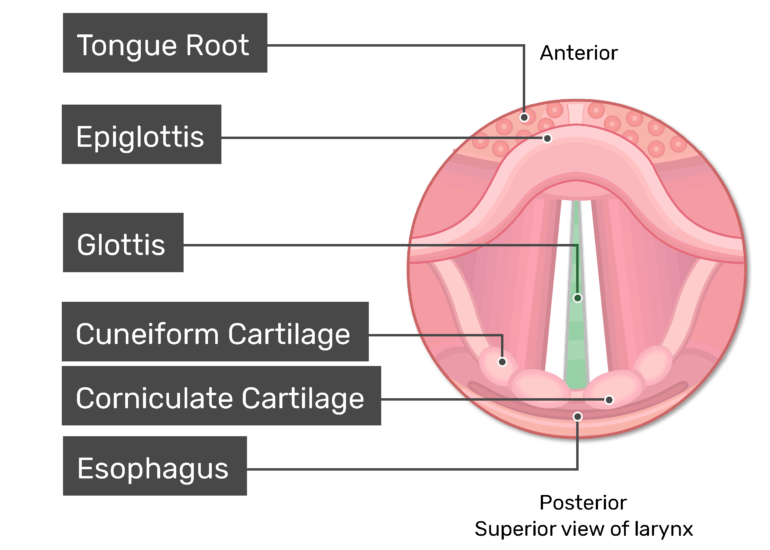
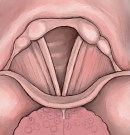 Glottis from above
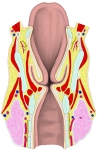 Larynx (coronal section)
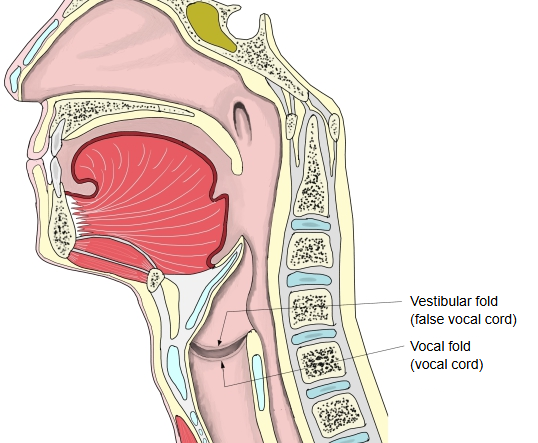
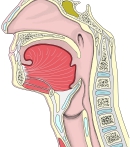 Larynx (median section)
Video: the glottis opening and closing
Reference websites
[Wikipedia]
· Glottis, Wikipedia.
[Websites with illustrations]
· Glottis (GetBodySmart)
· Coronal section of the larynx (Gray's Anatomy) (Wikimedia Commons)

Where it is found
Related terms
- Vocal fold
- Rima glottidis
- Vestibular fold
- Rima vestibuli
- Infraglottic cavity
- Laryngeal vestibule
- Larynx
References and sources
- Further reading: Glottis, Wikipedia.
- Federative International Programme for Anatomical Terminology (FIPAT). Terminologia Anatomica, 2nd ed. (TA2), 2019.