Laryngeal inlet (Latin: aditus laryngis)
Also called Laryngeal aperture or the laryngeal aditus
laryngeal inlet
- In front
- Upper border of the epiglottis : the free edge that curves down from the top of the epiglottis.
- At the sides
- Aryepiglottic fold : the upper edge of the quadrangular membrane in it forms the aryepiglottic ligament.
- Cuneiform cartilage : its upper part forms the cuneiform tubercle.
- Behind
- Arytenoid cartilage : its upper end, the apex, takes part.
- Corniculate cartilage : its upper part forms the corniculate tubercle.
- Interarytenoid notch : the notch reaching down between the right and left arytenoid apices.
All of these parts are covered by mucous membrane.
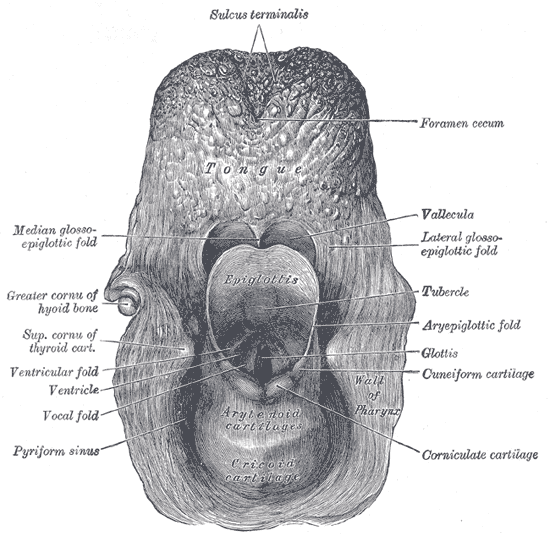
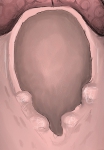 Laryngeal inlet (from behind)
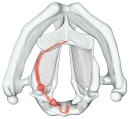 Laryngeal cartilages and the inlet
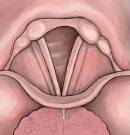 Larynx from above
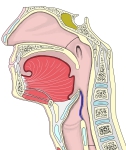 Pharynx and larynx (median section)
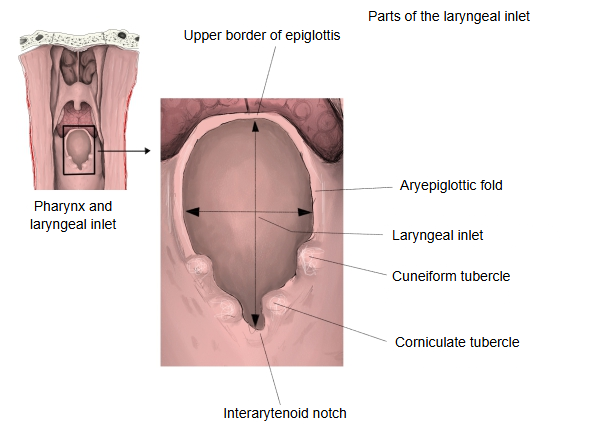
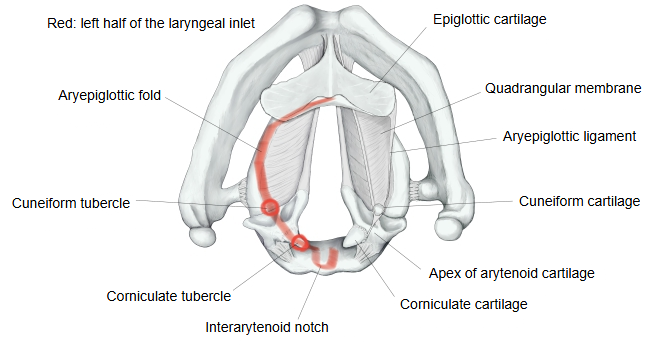
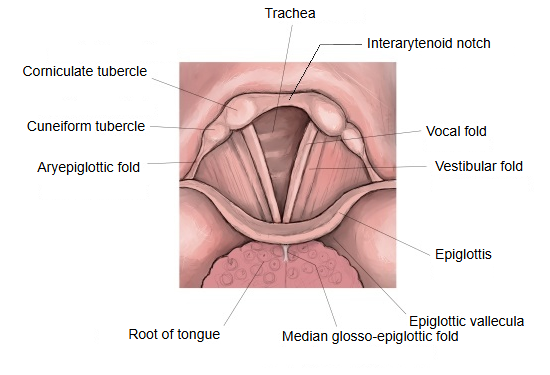
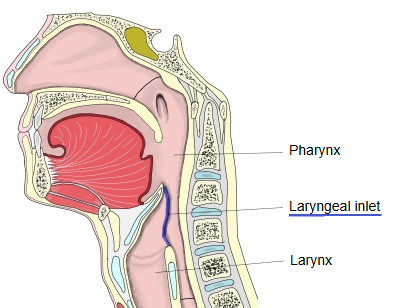
Through the inlet the larynx opens into the laryngopharynx; it faces backwards and upwards. The inlet is oval: in front it is bounded by the epiglottis and at the sides by the aryepiglottic folds, mucosal folds that contain the upper edge of the quadrangular membrane, fibres of the aryepiglottic and thyro-epiglottic muscles, and the cuneiform and corniculate cartilages over the arytenoid cartilages. At the back of each fold are two small mucosal elevations: the front one is the cuneiform tubercle, the back one the corniculate tubercle, each containing the cartilage of the same name. Behind, in the midline, is the interarytenoid notch, the gap between the two arytenoid cartilages.
· Below the inlet lies the laryngeal vestibule. During swallowing the inlet is narrowed by the aryepiglottic and arytenoid muscles and covered by the tilted epiglottis.
Reference websites
[Wikipedia]
· Laryngeal inlet, Wikipedia.
[Websites with illustrations]
· Entrance to the larynx seen from behind (Gray's Anatomy, fig. 955) (Wikimedia Commons)
· The larynx (TeachMeAnatomy)
Related terms
- Aryepiglottic fold
- Epiglottis
- Cuneiform tubercle
- Corniculate tubercle
- Interarytenoid notch
- Laryngeal vestibule
- Laryngopharynx
References and sources
- Further reading: Laryngeal inlet, Wikipedia.
- Federative International Programme for Anatomical Terminology (FIPAT). Terminologia Anatomica, 2nd ed. (TA2), 2019.