Anal glands (Latin: glandulae anales)
· They are one of the exocrine glands and secrete mucus.
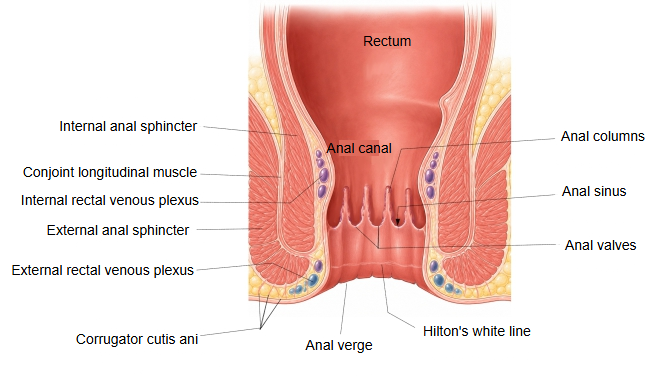
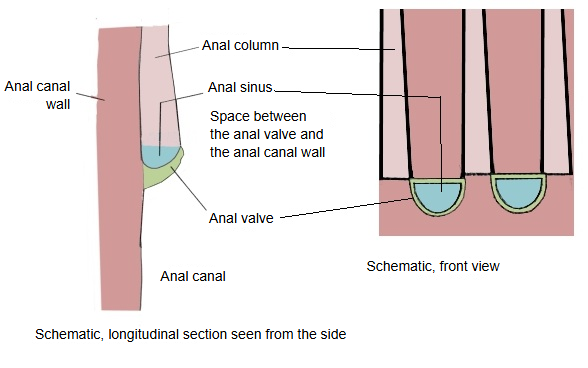
· Their ducts open into the anal sinuses at the level of the pectinate (dentate) line.
· There are usually about 4 to 10, more of them on the back wall of the canal; not every anal sinus receives a duct.
· Their branches run down and outward through the submucosa, and many reach into the internal anal sphincter; some extend as far as the space between the internal and external sphincters.
· Their mucus helps to lubricate the anal canal.
· Blockage and infection of an anal gland (cryptoglandular infection) is the usual starting point of an anorectal abscess and of most anal fistulas.
Note: in humans these glands are not the same as the anal sacs of dogs and cats, or the sweat and sebaceous glands of the skin around the anus.
Where it is found
Related terms
References and sources
- Further reading: Anal canal, Wikipedia.
- Further reading: Anal fistula, Wikipedia.
- Federative International Programme for Anatomical Terminology (FIPAT). Terminologia Anatomica, 2nd ed. (TA2), 2019.