Conjoint longitudinal muscle
Also called the conjoined longitudinal muscle or the longitudinal muscle of the anal canal
layers of
the anal
canal
- Internal anal sphincter : encircles the anal canal like a tube; smooth muscle (involuntary), supplied by autonomic nerves: sympathetic fibres from the hypogastric nerves and plexuses and the parasympathetic pelvic splanchnic nerves.
- External anal sphincter : lies outside the internal anal sphincter; striated muscle (voluntary), supplied mainly by the inferior anal (rectal) nerves from the pudendal nerve.
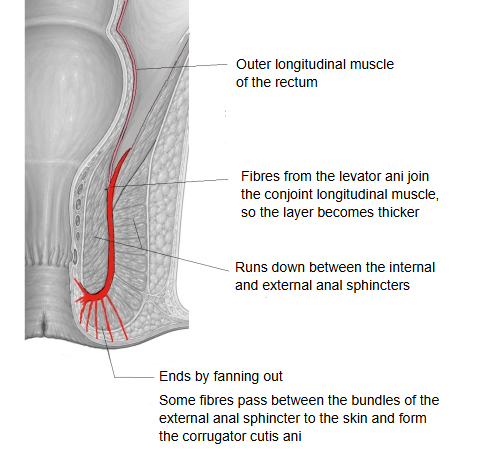
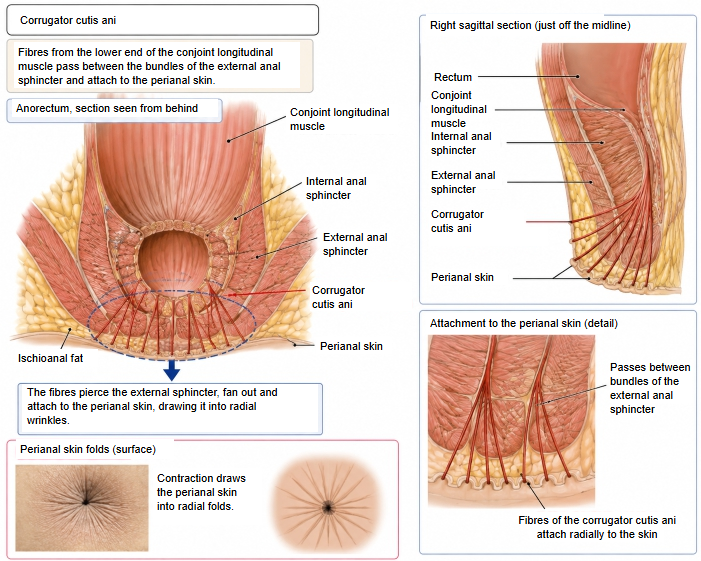
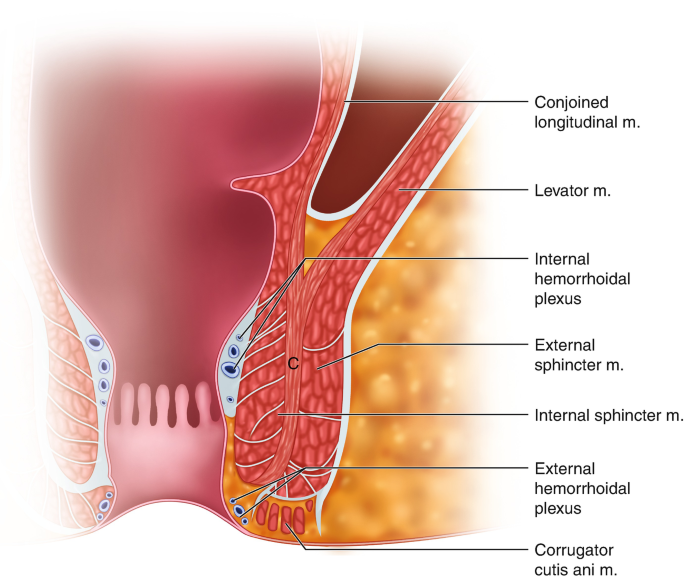
- Conjoint longitudinal muscle : continues the outer longitudinal muscle of the rectum and is joined on the way by fibres of the levator ani; it runs down between the internal and external anal sphincters. At its lower end, the bundles that pass through the external anal sphincter become the corrugator cutis ani.
· It descends in the intersphincteric space, between the internal anal sphincter on the inside and the external anal sphincter on the outside.
· Because fibres of the levator ani, mainly from the puborectalis region, join it at the anorectal junction, it contains both smooth and striated muscle; sources differ on how much of it is striated.
· Near the lower end of the internal sphincter it breaks up into fibroelastic strands that fan out. Some pass through the subcutaneous part of the external sphincter to the skin around the anus (the corrugator cutis ani, which wrinkles the perianal skin); others pass inward through the internal sphincter to the submucosa of the anal canal (the mucosal suspensory ligament), helping to hold the lining in place.
· It is thought to bind the layers of the anal canal together and to help shorten and widen the canal during defecation; weakening of these supports is linked with the prolapse of haemorrhoids.
Reference websites
[Wikipedia]
· Anal canal, Wikipedia.
· Internal anal sphincter, Wikipedia.
[Websites with illustrations]
· Muscles of the anal canal (journal figure) (Springer Nature)

· Anal canal and sphincters (book figure) (Springer Nature)
· Anatomy of the anal canal (journal figure) (Elsevier)

Where it is found
Related terms
References and sources
- Further reading: Anal canal, Wikipedia.
- Further reading: Internal anal sphincter, Wikipedia.
- Federative International Programme for Anatomical Terminology (FIPAT). Terminologia Anatomica, 2nd ed. (TA2), 2019.