Pharyngeal raphe (Latin: raphe pharyngis)
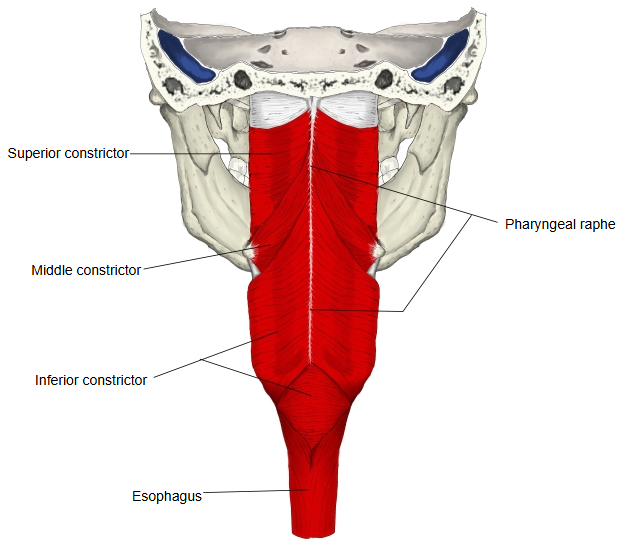
The pharyngeal raphe is the line that runs vertically down the middle of the back wall of the pharynx.
Line: a seam of dense fibrous tissue, the same kind of tissue as in ligaments and tendons; it joins the right and left halves of the posterior pharyngeal wall
It is the attachment of the pharyngeal constrictors, the outer muscle layer of the pharynx, and of some fibres of the palatopharyngeus.
Muscle layers of the pharynx: an outer, roughly circular layer and an inner, longitudinal layerPharyngeal constrictors: the superior, middle and inferior constrictors (the thyropharyngeal part of the inferior one) of the right and left sides meet here
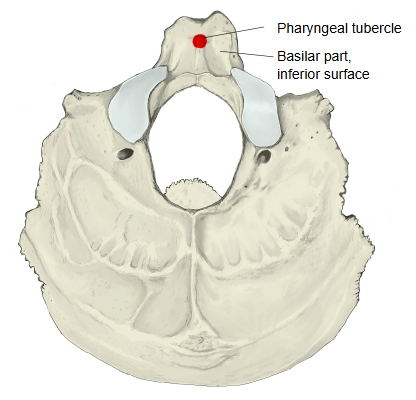
Above, it is attached to the pharyngeal tubercle; below, at about the level of the sixth cervical vertebra, it blends with the back wall of the esophagus.
Pharyngeal tubercle: a small bump near the middle of the underside of the basilar part of the occipital bone
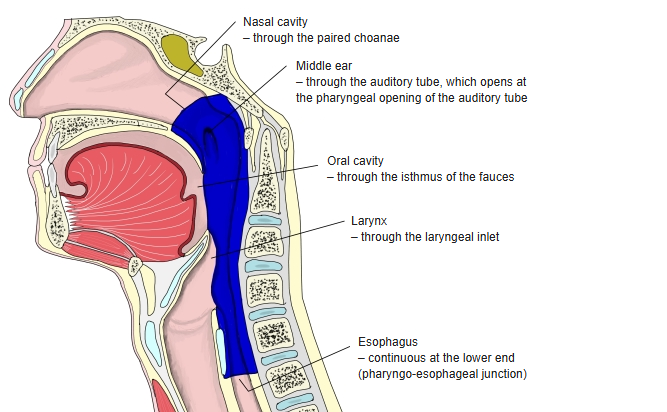
Pharynx: a muscular, bag-like tube whose cavity, lined with mucous membrane, is the passage for both food and air.
Palatopharyngeus: one of the muscles of the soft palate and fauces.
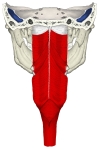 Pharyngeal constrictors (posterior view)
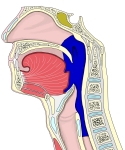 Pharynx (median section)
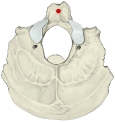 Pharyngeal tubercle (occipital bone, inferior view)
Reference websites
[Wikipedia]
· Pharyngeal raphe, Wikipedia.
· Pharynx, Wikipedia.
[Websites with illustrations]
· Pharynx: muscles, arteries and nerves (Kenhub)
· The pharynx (TeachMeAnatomy)
Related terms
- Pharynx
- Pharyngeal constrictors (posterior view)
- Inferior pharyngeal constrictor
- Palatopharyngeus
- Esophagus
- Occipital bone
- Nasopharynx
References and sources
- Further reading: Pharyngeal raphe, Wikipedia.
- Further reading: Pharynx, Wikipedia.
- Federative International Programme for Anatomical Terminology (FIPAT). Terminologia Anatomica, 2nd ed. (TA2), 2019.