External axis of eyeball (Latin: axis bulbi externus)
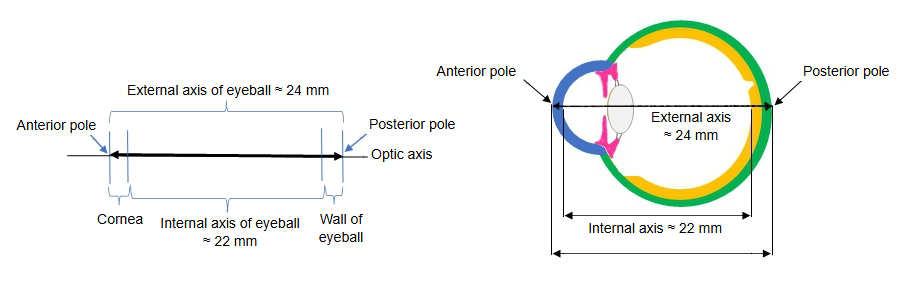
In adults the external axis measures about 24 mm and the internal axis about 22 mm. The side-to-side and up-and-down diameters are also about 24 mm, so the eyeball is almost a sphere. The internal axis is the same line measured inside the eye, from the back of the cornea to the inner surface of the retina; the difference is the thickness of the cornea at the front and of the eyeball wall at the back. A longer axis than normal is a common cause of short-sightedness (myopia); a shorter one, of long-sightedness.
Put another way, it is the part of the optic axis that runs from the middle of the front surface of the cornea, through the lens and the vitreous body, to the posterior pole on the outer surface of the sclera.
Related terms
References and sources
- Further reading: Human eye, Wikipedia.
- Federative International Programme for Anatomical Terminology (FIPAT). Terminologia Anatomica, 2nd ed. (TA2), 2019.