Conjunctival fossa
Note about this page
This entry was written provisionally because no original material was available for it. Please check its content against the sources listed below. The name is not part of Terminologia Anatomica, and sources differ in how they use it.
· The conjunctival fossa is the name used for the small pits seen on the palpebral conjunctiva (the part of the conjunctiva that lines the inner surface of the eyelids). The palpebral conjunctiva is firmly attached to the tarsal plate, and its surface shows small depressions (conjunctival fossae).
· Over the tarsus the palpebral conjunctiva is rich in blood vessels and tightly bound to the tarsal plate, so that it shows small pits (conjunctival fossae).
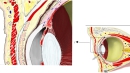 Front of eye (sagittal section)
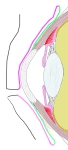 Parts of the conjunctiva (diagram)
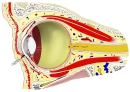 Orbit (sagittal section)
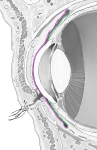 Front of orbit (sagittal section)
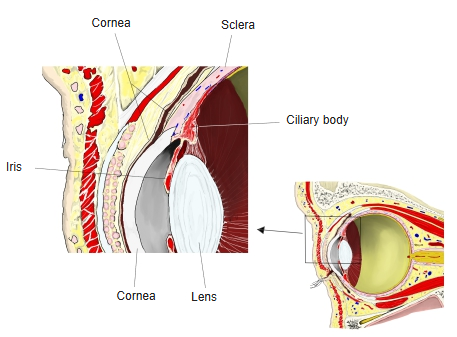
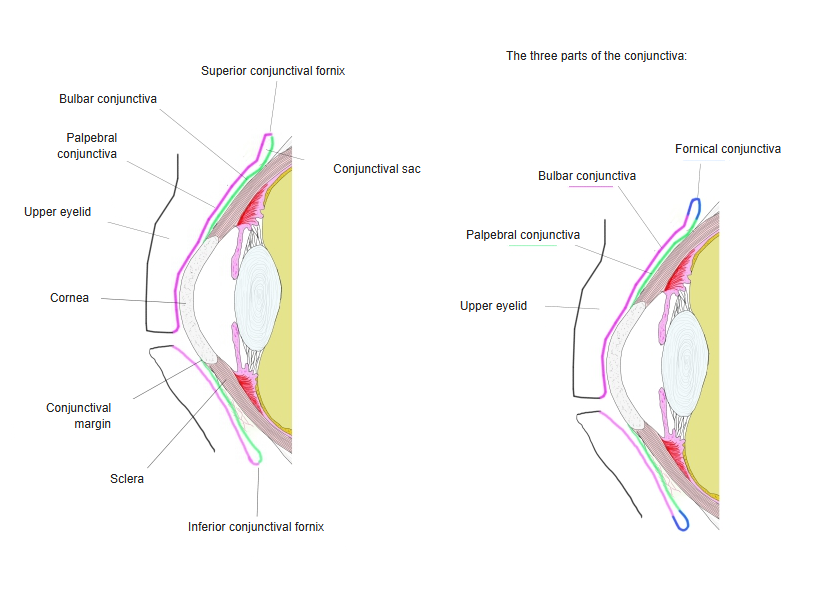
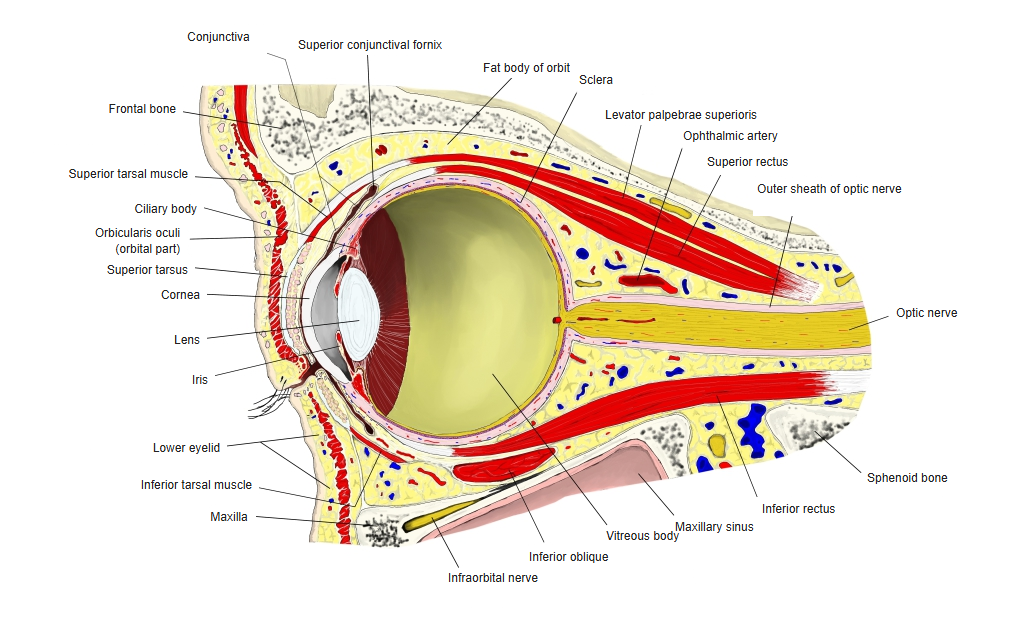
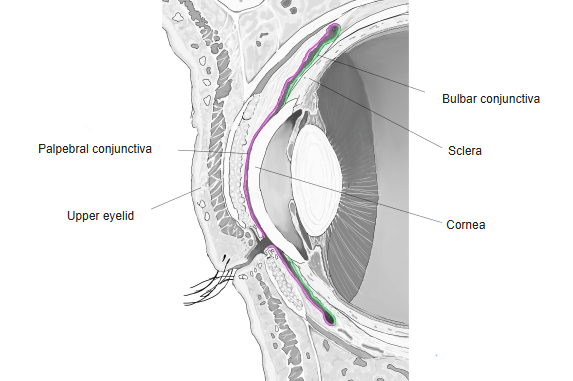
· The palpebral conjunctiva is covered by a two-layered or stratified columnar epithelium with goblet cells, resting on a loose lamina propria rich in blood vessels. Its surface is thick and not transparent, and has many small papillae.
· In contrast to the palpebral conjunctiva, which is firmly attached to the tarsal plate, the fornical conjunctiva, where the membrane turns back from the palpebral to the bulbar conjunctiva, is loose and flexible, so that it does not hinder the movements of the eyelids and the eyeball. The space between the palpebral and bulbar conjunctiva is the conjunctival sac.
More details
· For the features of the palpebral conjunctiva see Palpebral conjunctiva; for the parts of the whole conjunctiva see Conjunctiva. See also Edge of eyelid and Lower eyelid.
Reference websites
[Wikipedia]
· Conjunctiva, Wikipedia.
[Websites with illustrations]
· The tarsal plates and their ligaments (Gray's Anatomy, fig. 894) (Wikimedia Commons)

· Anatomy of the eye (Gray's Anatomy, fig. 869) (Wikimedia Commons)

Related terms
References and sources
- Further reading: Conjunctiva, Wikipedia.
- Federative International Programme for Anatomical Terminology (FIPAT). Terminologia Anatomica, 2nd ed. (TA2), 2019.