Bulbar conjunctiva (Latin: tunica conjunctiva bulbi)
Also called Ocular conjunctiva
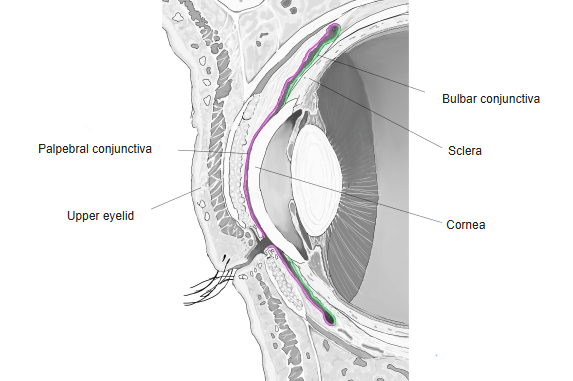
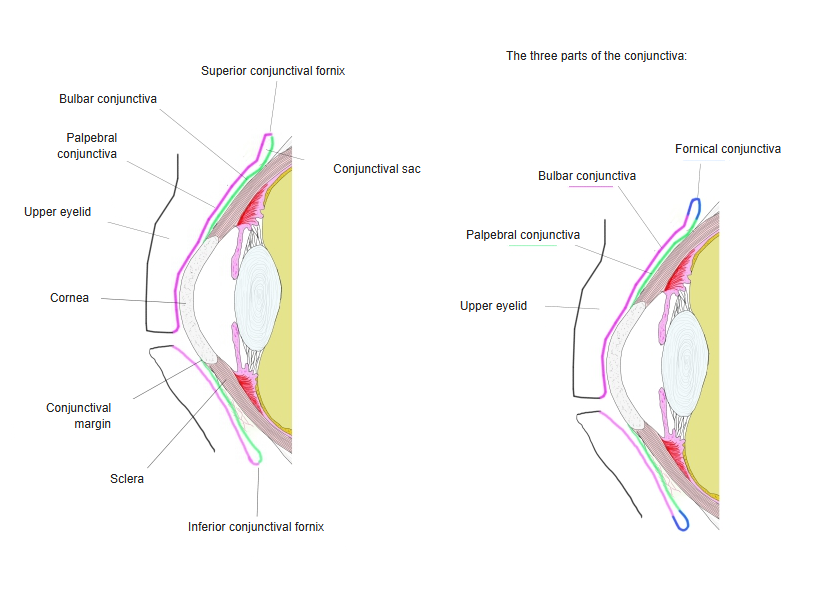
- Palpebral conjunctiva : the membrane covering the back of the eyelids; a two-layered or stratified columnar epithelium, rich in blood vessels.
- Bulbar conjunctiva : the part covering the eyeball; a non-keratinized stratified squamous epithelium.
- Fornical conjunctiva : some sources (for example Wikipedia) add it as a third part, between the two above.
The bulbar conjunctiva has the following features.
· It is a non-keratinized stratified squamous epithelium, poor in goblet cells (fewer than in the fornix).
· Its lamina propria is loose and poor in cells and contains elastic fibres, so the membrane is thin, transparent and slides easily over the sclera.
· It reaches from the conjunctival fornix to the edge of the cornea; this edge is the conjunctival margin, at the corneal limbus, where it is firmly attached and continues as the epithelium of the cornea.
· At the medial angle of the eye the conjunctiva forms a small reddish elevation, the lacrimal caruncle.
· Lateral to the lacrimal caruncle lies a crescent-shaped fold of the conjunctiva, the semilunar fold (plica semilunaris).
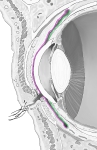 Front of the eyeball (sagittal section)
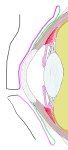 Conjunctiva (diagram)
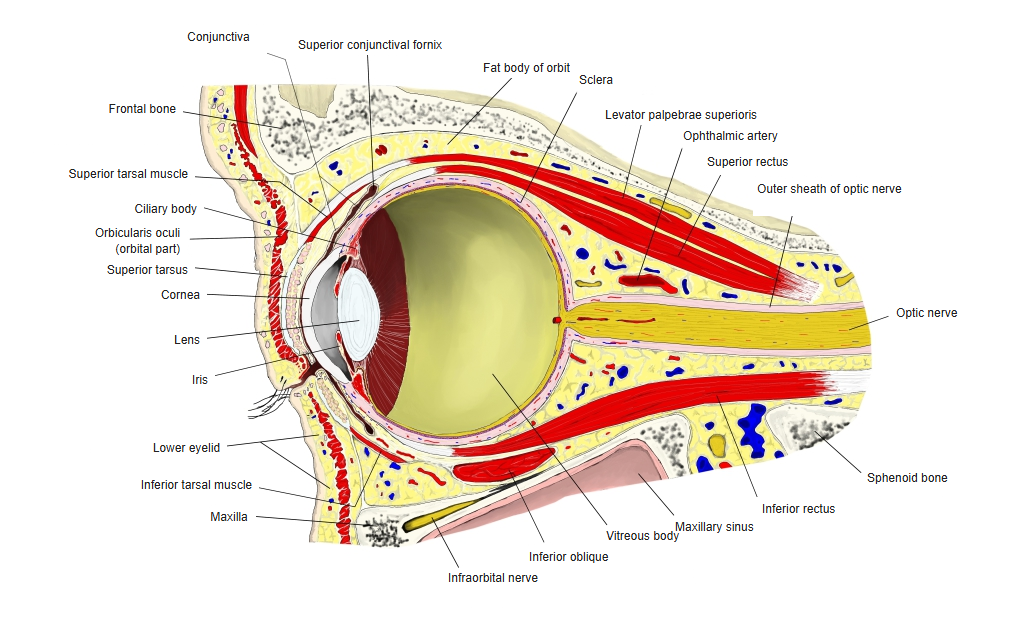
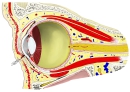 Orbit (sagittal section)
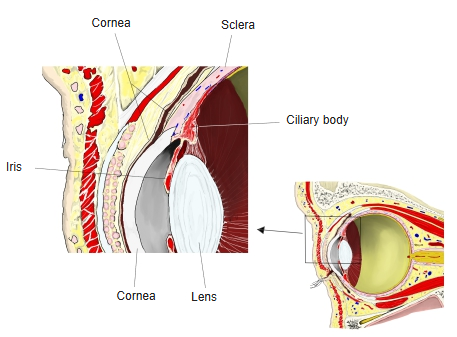
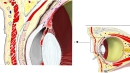 Front of the orbit (sagittal section)
Over the sclera the conjunctiva is only loosely attached to the eyeball; it is thin and transparent, has no papillae and few vessels. Its fine vessels, the conjunctival arteries and veins, become visible when the eye is red. Over the cornea only its epithelium continues, as the corneal epithelium.
Reference websites
[Wikipedia]
· Conjunctiva, Wikipedia.
Related terms
References and sources
- Further reading: Conjunctiva, Wikipedia.
- Federative International Programme for Anatomical Terminology (FIPAT). Terminologia Anatomica, 2nd ed. (TA2), 2019.