Molar glands (Latin: glandulae molares)
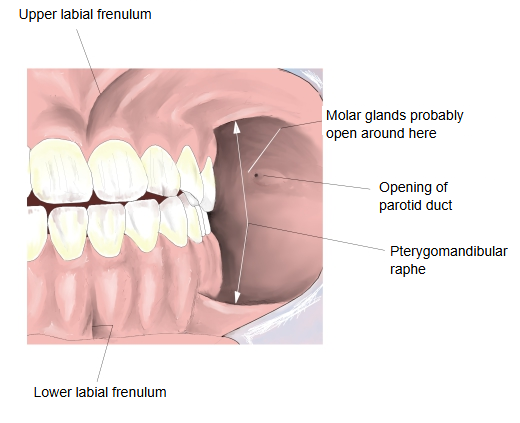
The molar glands are one of the minor salivary glands: mixed glands at the back part of the cheek, lying between the masseter and the buccinator, whose ducts open opposite the last upper molar teeth.
Minor salivary glands: lie in the oral mucosa and release saliva directly or through small ducts
Note: detailed descriptions are few. Sources differ: many texts count them as the outer group of the buccal glands.
Minor
salivary
glands
salivary
glands
- Labial glands : in the mucosa of the lips; mixed. Few at the corners of the mouth; some lie in the muscle layer.
- Buccal glands : in the mucosa of the cheeks; mixed. Some also lie outside the buccinator.
- Molar glands : at the back of the cheek, between the masseter and the buccinator; mixed. They open opposite the last upper molar teeth.
- Palatine glands : in the back of the hard palate and throughout the soft palate (sources differ on where they are densest); mucous.
- Lingual glands : three groups by position:
- Anterior lingual glands : on each side of the underside of the tip of the tongue; mixed. Their ducts open beside the lingual frenulum.
- Posterior lingual glands : in the root of the tongue and the back of its lateral margins; mucous.
- Glands of von Ebner : serous; they open into the trenches of the vallate papillae and foliate papillae.
The molar glands are a small group of mixed (seromucous) glands lying between the masseter and the buccinator and beneath the mucosa around the end of the duct of the parotid gland. Their small ducts pierce the buccinator and open on the inner surface of the cheek opposite the last upper molar teeth, close to the opening of the parotid duct. With the labial, buccal, palatine and lingual glands they belong to the minor salivary glands of the mouth (salivary glands).
Related terms
References and sources
- Further reading: Buccal glands, Wikipedia.
- Federative International Programme for Anatomical Terminology (FIPAT). Terminologia Anatomica, 2nd ed. (TA2), 2019.