Uvula (Latin: uvula palatina)
Also called the palatine uvula
· It is usually cone-shaped, but now and then the tip is split in two (a bifid uvula).
(A bifid uvula is found in about 2% of people, but more often in some populations; figures of about 10% have been reported in some Native American groups.)
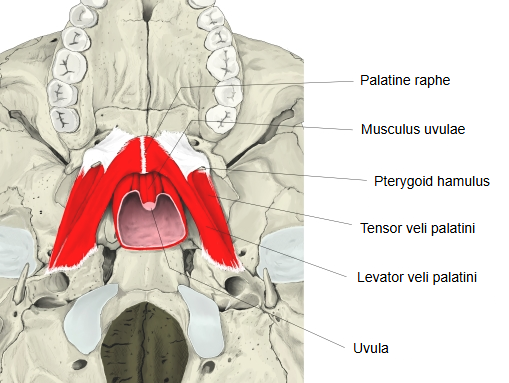
Its muscle, the musculus uvulae, shortens and lifts the uvula and is supplied by the vagus nerve through the pharyngeal plexus. The palatoglossal arch and palatopharyngeal arch run down from the soft palate on each side of it.
Functions (a short summary)
· Keeps food from entering the nasal cavity: in swallowing it rises with the soft palate and helps to seal off the nasopharynx.
· Keeps the throat moist by the secretion of thin saliva from its glands.
· Helps in speech: in many languages it is used to form the uvular consonants.
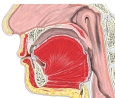 Mouth and pharynx (section)
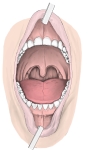 Open mouth, front view
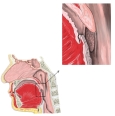 Around the uvula (section)
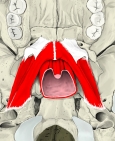 Muscles of the soft palate (from below)
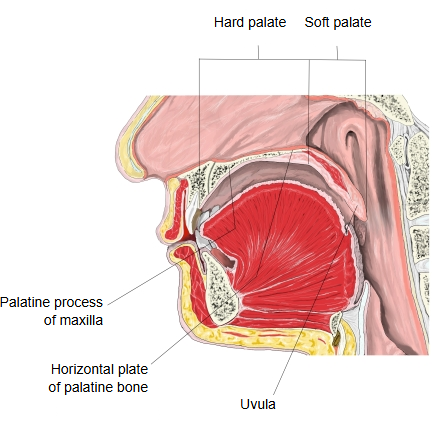
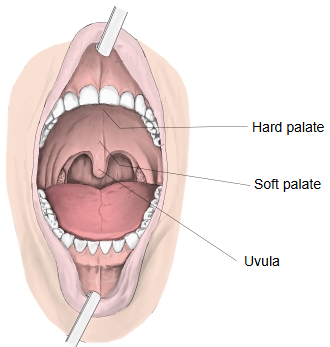
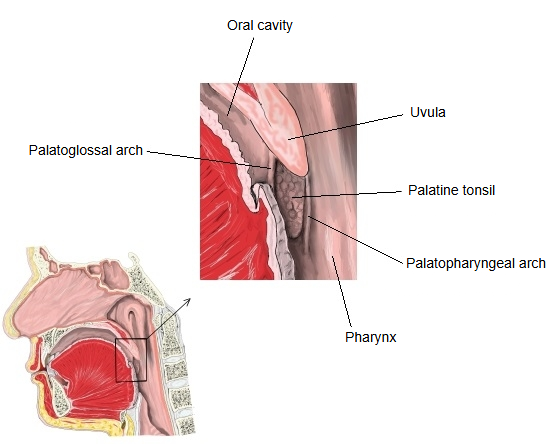
When the mouth is closed and breathing is quiet, the uvula hangs almost straight down with the velum palatinum, its tip resting on the back of the tongue, and the mouth opens into the cavity of the pharynx only through small gaps on each side of it. In swallowing, the tip of the tongue is pressed against the hard palate and the tongue moves quickly backward; the uvula and the velum rise and touch the back wall of the pharynx, so that the food passes from the mouth into the pharynx and not into the nose. If the palatine muscles (supplied by the vagus nerve) are paralysed, food and liquid can pass into the nose; if the laryngeal muscles (recurrent laryngeal nerve) are paralysed, the laryngeal inlet does not close in swallowing, food may enter the airway, and aspiration pneumonia can follow.
Reference websites
[Wikipedia]
· Palatine uvula, Wikipedia.
· Soft palate, Wikipedia.
[Websites with illustrations]
· The palate (TeachMeAnatomy)
· Palate (Kenhub)
Related terms
- Soft palate
- Palate
- Musculus uvulae
- Palatoglossal arch
- Palatopharyngeal arch
- Palatine tonsil
- Levator veli palatini
References and sources
- Further reading: Palatine uvula, Wikipedia.
- Further reading: Soft palate, Wikipedia.
- Federative International Programme for Anatomical Terminology (FIPAT). Terminologia Anatomica, 2nd ed. (TA2), 2019.