Cavity of pharynx (Latin: cavitas pharyngis)
Also called Pharyngeal cavity
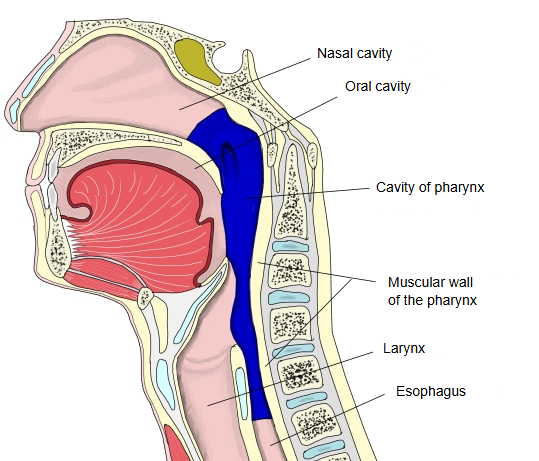
The space inside the pharynx, lined by mucous membrane, from the base of the skull down to the start of the esophagus.
In front it opens into the nasal cavity (through the choanae), the mouth (through the isthmus of fauces) and the larynx (through the laryngeal inlet). Below, at the lower border of the cricoid cartilage (about the sixth cervical vertebra), it continues into the esophagus.
It is a shared passage where the routes of air and food cross. Its wall is muscular (constrictors outside, elevator muscles inside), which lets it narrow and shorten during swallowing.
More detail
The name is probably meant to separate the space from the "pharynx" as an organ with a muscular wall, but many sources do not distinguish "pharynx" and "cavity of pharynx": they use "pharynx" for both the muscular tube and the space inside it.
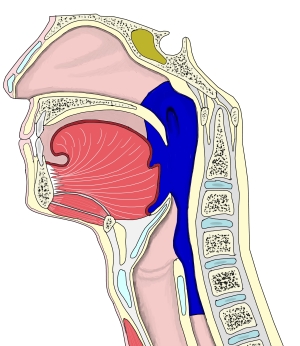
Some sources also include in the cavity of the pharynx a region that seems to belong to the oral cavity; drawings vary in how much of the space behind the mouth they include.
The pharynx can be divided into the following three parts.
| 1 | Nasal part of pharynx (= epipharynx, nasopharynx) | Behind the nasal cavity, above the soft palate. | 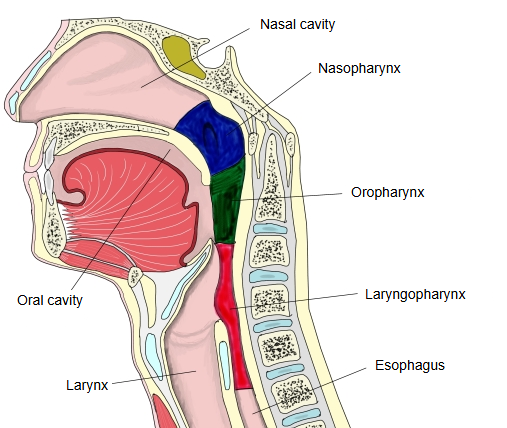 |
| 2 | Oral part of pharynx (= oropharynx, mesopharynx) | Behind the mouth, from the soft palate to the upper border of the epiglottis. | |
| 3 | Laryngeal part of pharynx (= laryngopharynx, hypopharynx) | Behind the larynx, down to the esophagus; the piriform recesses lie on each side. |
Reference websites
[Wikipedia]
· Pharynx, Wikipedia.
[Websites with illustrations]
· The pharynx (TeachMeAnatomy)
· Pharynx (Kenhub)
Related terms
References and sources
- Further reading: Pharynx, Wikipedia.
- Federative International Programme for Anatomical Terminology (FIPAT). Terminologia Anatomica, 2nd ed. (TA2), 2019.