Palatine raphe (Latin: raphe palati)
Also called the median palatine raphe
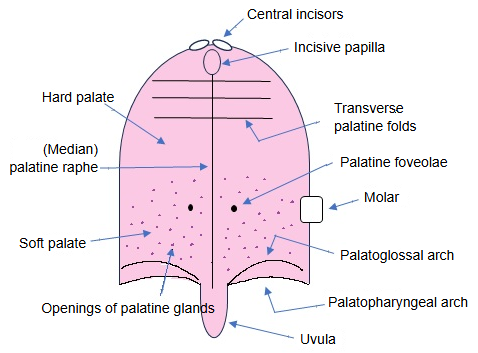
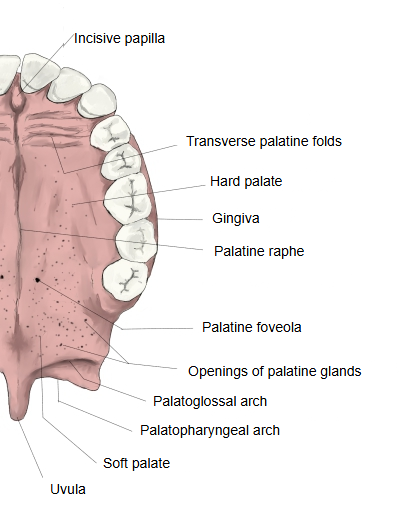
· Its front end is the incisive papilla, behind the upper central incisors, and its back end is the uvula; it crosses the hard palate and the soft palate. The transverse palatine folds spread sideways from its front part.
Note: it is not clear whether the raphe runs along the whole uvula or ends at its base.
Images found on the internet show both: some with the raphe running along the whole uvula, others with it ending at the base.
· There is no submucosa beneath the palatine raphe: along the raphe the mucosa is bound directly to the bone, so the glands and fat found further out are absent here.
· It is a tendinous raphe.
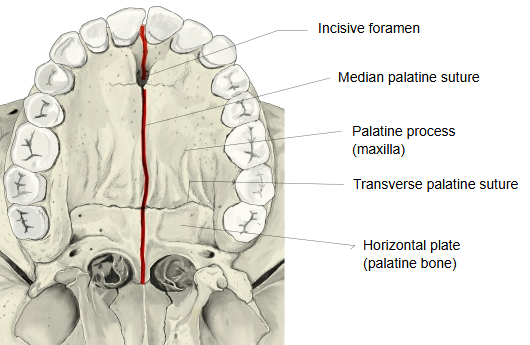
Its surface is covered by mucous membrane. Over the hard palate it marks the line of the median palatine suture beneath; over the soft palate it overlies a midline tendinous band where the palatine muscles of the two sides meet.
· Some sources give the raphe as an attachment of the following three muscles; this site does not treat it as their attachment (other sources give the palatine aponeurosis instead).
Tensor veli palatini, levator veli palatini, palatoglossus
 Mucosa of the palate
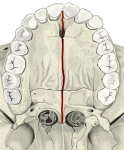 Median palatine suture
Reference websites
[Wikipedia]
· Palatine raphe, Wikipedia.
· Hard palate, Wikipedia.
Related terms
- Palate
- Hard palate
- Soft palate
- Transverse palatine folds
- Palatine process
- Transverse palatine suture
- Incisive canal
References and sources
- Further reading: Palatine raphe, Wikipedia.
- Further reading: Hard palate, Wikipedia.
- Federative International Programme for Anatomical Terminology (FIPAT). Terminologia Anatomica, 2nd ed. (TA2), 2019.