Postglenoid process
Also called the postglenoid tubercle
Note: many anatomy textbooks do not name this part, and it is not listed in Terminologia Anatomica. English-language illustrations often label it, and some use the word tubercle (postglenoid tubercle) instead of process.
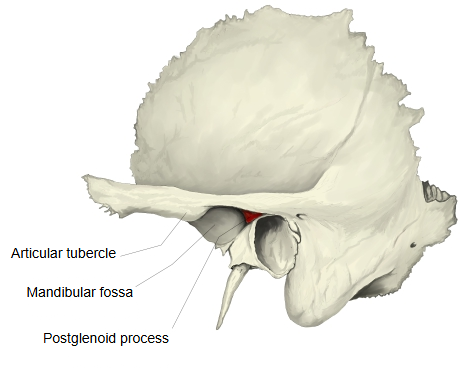
Position
It is a small downward projection of the temporal bone that separates the mandibular fossa from the external acoustic meatus and forms the posterior wall of the fossa. The articular tubercle lies in front of the fossa; the postglenoid process lies behind it. It belongs to the squamous part of the temporal bone and lies just in front of the tympanic part. Its size varies between individuals.
Reference websites
[Wikipedia]
· Mandibular fossa, Wikipedia.
[Websites with illustrations]
· Section of the temporomandibular joint with the postglenoid process labelled (fidanoski.ca)

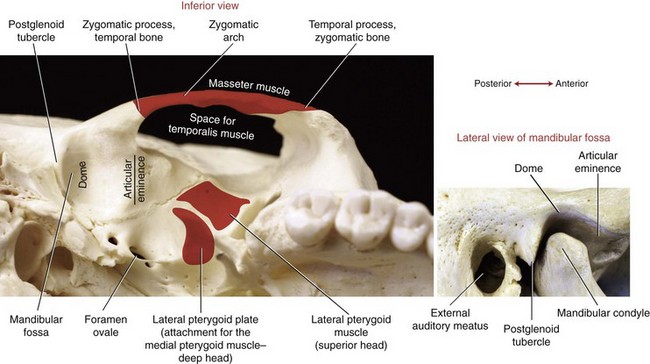
· Mandibular fossa and postglenoid tubercle (inferior and lateral views) (Clinical Gate)
Related terms
- Temporal bone
- Articular tubercle
- Temporomandibular joint
- Head of mandible
- External acoustic meatus
- Tympanic part
- Squamous part
References and sources
- Further reading: Mandibular fossa, Wikipedia.
- Federative International Programme for Anatomical Terminology (FIPAT). Terminologia Anatomica, 2nd ed. (TA2), 2019.