Posterior antebrachial region (Latin: regio antebrachii posterior)
Also called the posterior region of forearm
The posterior antebrachial region
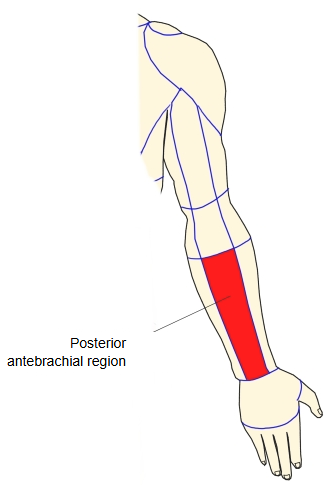
In the anatomical regions of the body, the posterior antebrachial region is one of the regions of the upper limb: the part in the middle of the back of the forearm.
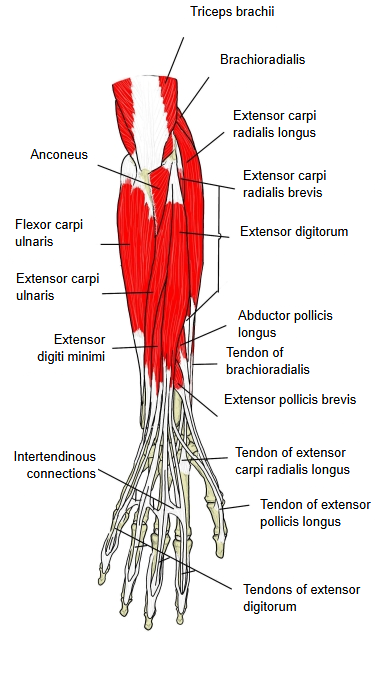
It continues from the posterior cubital region above.The extensor muscles, such as extensor digitorum, extensor digiti minimi and extensor carpi ulnaris, lie here.It is paired: there are a right and a left posterior antebrachial region.
It is the back (extensor) surface of the forearm, from the elbow down to the wrist; below, it reaches the dorsum of the hand. The extensor muscles of the wrist and fingers lie over the radius and ulna. The skin here is supplied mainly by the posterior cutaneous nerve of forearm.
 Posterior antebrachial region
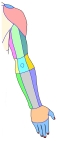 Regions of the upper limb (posterior)
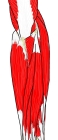 Muscles of the forearm (posterior)
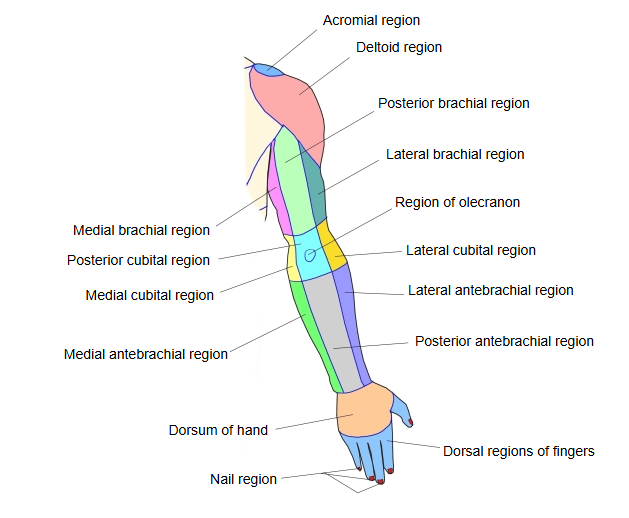
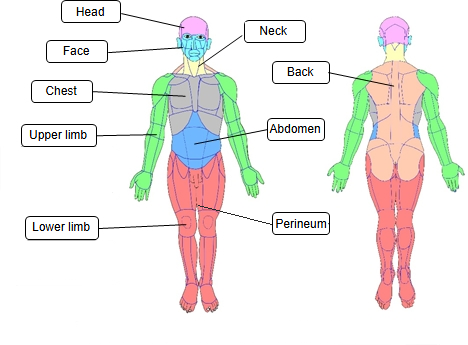
On this site the body is divided into three main parts, the head and neck, the trunk and the limbs, and the limbs into the upper and lower limbs. Each part is divided further into smaller regions.
Regions
of the
body
of the
body
- Head and neck : 1. head (head, face) 2. neck
- Trunk : 1. chest 2. abdomen 3. back
- Limbs
- Upper limb : 1. shoulder 2. arm 3. elbow 4. forearm 5. hand
- Lower limb : 1. perineum 2. thigh 3. knee 4. leg 5. foot
Related terms
- Lateral antebrachial region
- Extensor digitorum
- Extensor digiti minimi
- Extensor carpi ulnaris
- Radius
- Ulna
- Posterior cutaneous nerve of forearm
References and sources
- Further reading: Forearm, Wikipedia.
- Federative International Programme for Anatomical Terminology (FIPAT). Terminologia Anatomica, 2nd ed. (TA2), 2019.