Laryngeal cartilages (Latin: cartilagines laryngis)
· The hyaline laryngeal cartilages often begin to ossify or calcify from the third decade onwards (age 20-30); the elastic cartilages do not.
Most laryngeal cartilages are hyaline cartilage, but some are elastic cartilage. One point is worth noting: the vocal process of the arytenoid cartilage is elastic cartilage,
although the rest of the arytenoid is hyaline; the apex of the arytenoid is elastic as well.
All the laryngeal muscles are striated muscle. The thyroid and cricoid cartilages and most of each arytenoid cartilage are hyaline cartilage; the epiglottic cartilage, the vocal process of the arytenoid, and the corniculate and cuneiform cartilages are elastic cartilage.
The chart below is a short overview of the laryngeal cartilages.
cartilages
- Unpaired
- Thyroid cartilage : the largest; its two laminae form most of the front wall and the laryngeal prominence. (hyaline)
- Cricoid cartilage : the lowest; a complete ring, joined to the first tracheal cartilage by the cricotracheal ligament. (hyaline)
- Epiglottic cartilage : the framework of the epiglottis. (elastic)
- Paired
- Arytenoid cartilage : sits on the upper border of the cricoid lamina; the most important for voice production. (hyaline; vocal process and apex elastic)
- Corniculate cartilage : a very small cartilage on the apex of the arytenoid cartilage. (elastic)
- Cuneiform cartilage : a small, flat cartilage in front of and lateral to the corniculate cartilage; often absent. (elastic)
- Sesamoid cartilages : small inconstant cartilages, sometimes several. The triticeal cartilage in the lateral thyrohyoid ligament is also inconstant.
The framework of the larynx is made by the laryngeal cartilages, joined to each other by ligaments. The extrinsic laryngeal muscles move the larynx as a whole; the intrinsic laryngeal muscles move the cartilages against each other, changing the shape of the glottis and the tension of the vocal folds. The laryngeal cavity is lined with mucosa that forms the folds needed for voice production. Some sources leave the corniculate and cuneiform cartilages out of the main list and count them with the minor cartilages, so the number of main cartilages differs.
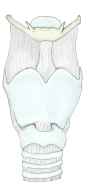 Larynx (anterior view)
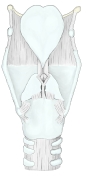 Larynx (posterior view)
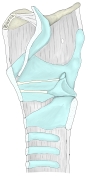 Larynx (median section)
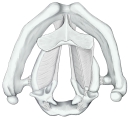 Laryngeal cartilages and membranes (superior view)
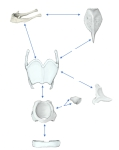 Laryngeal cartilages and ligaments
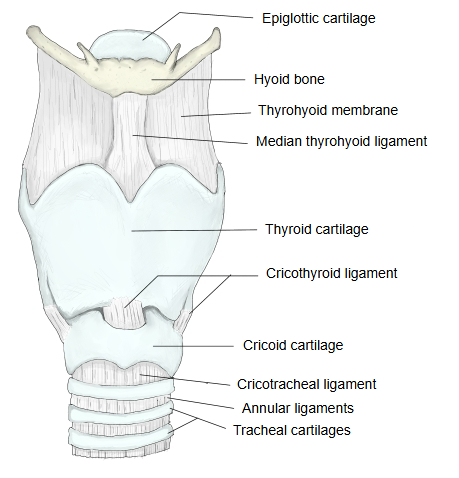
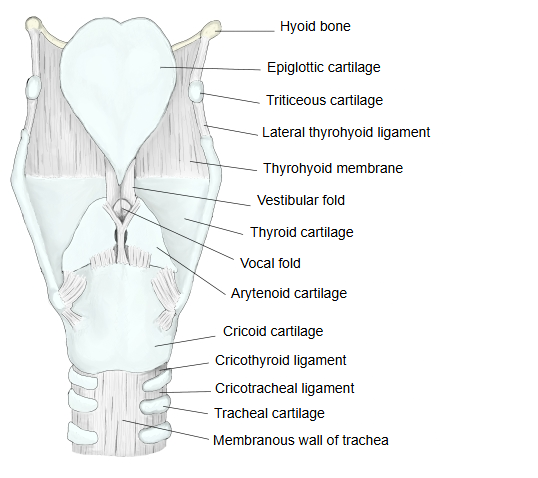
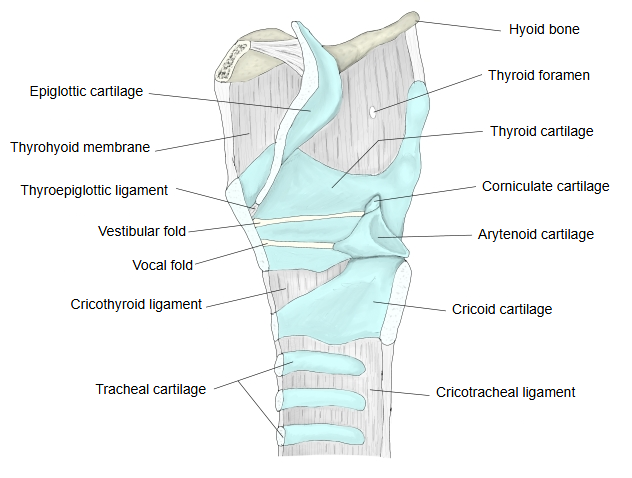
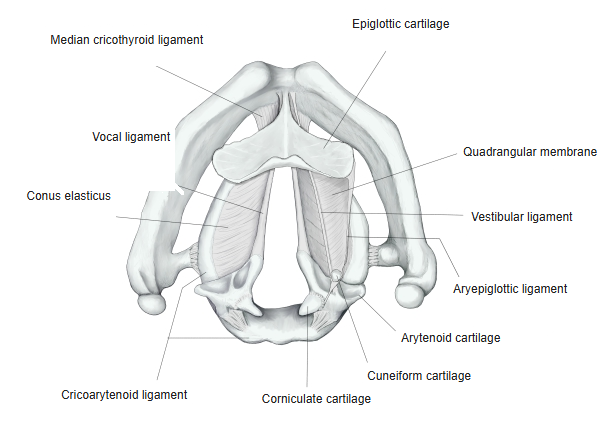
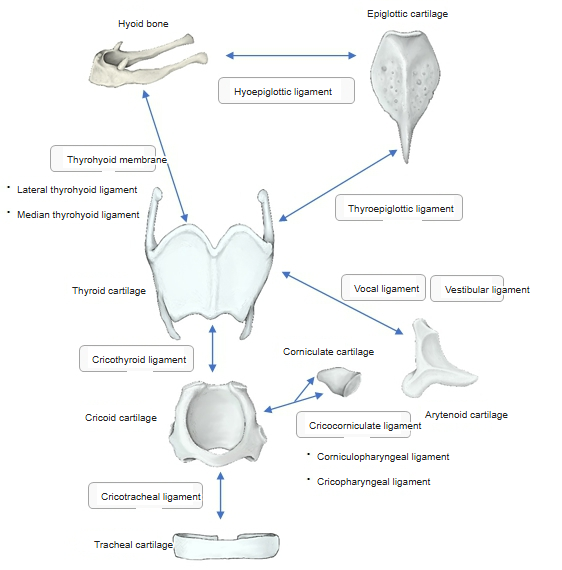
In all there are nine main cartilages: three unpaired and three paired, plus a few small inconstant ones.
Reference websites
[Wikipedia]
· Larynx, Wikipedia.
· Cricoid cartilage, Wikipedia.
· Arytenoid cartilage, Wikipedia.
[Websites with illustrations]
· Larynx, anterolateral view (Wikimedia Commons)

· The cartilages of the larynx, posterior view (Gray's Anatomy) (Wikimedia Commons)

· The larynx (TeachMeAnatomy)
Video
Related terms
- Thyroid cartilage
- Arytenoid cartilage
- Cuneiform cartilage
- Epiglottis
- Larynx
- Cricothyroid ligament
- Tracheal cartilages
References and sources
- Further reading: Larynx, Wikipedia.
- Further reading: Cricoid cartilage, Wikipedia.
- Federative International Programme for Anatomical Terminology (FIPAT). Terminologia Anatomica, 2nd ed. (TA2), 2019.