Diaphysis (Latin: diaphysis)
Also called the shaft
Its wall is made of compact bone; spongy bone is found mainly towards the ends of the bone.
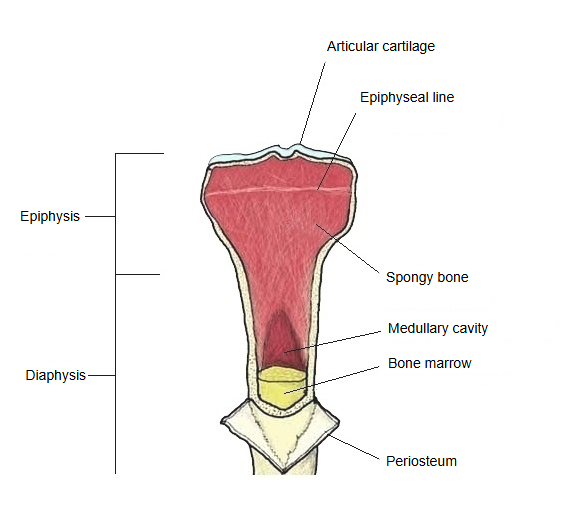
Inside is a long hollow, the medullary cavity, which holds the bone marrow. The shaft often takes outside forces directly, so its outer layer is strong compact bone; this compact bone is thickest near the middle of the shaft and where the load is greatest.
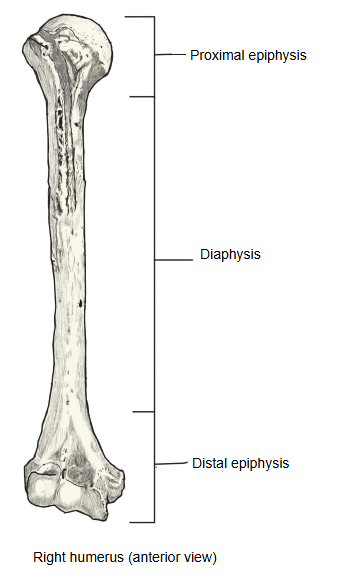
The marrow in the cavity may be red or yellow (fatty). The shaft is covered by the periosteum, and one or more nutrient foramina let the nutrient artery through to the marrow. Bone formation in a long bone starts in the diaphysis, at the primary ossification centre; the shaft of the humerus (shaft of humerus) and of the femur (shaft of femur) are examples.
Reference websites
[Wikipedia]
· Diaphysis, Wikipedia.
· Long bone, Wikipedia.
[Websites with illustrations]
· Parts of a long bone (figure) (Study.com)
· Structure of a long bone (figure) (BBC Bitesize archive)
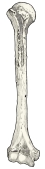 Right humerus (anterior view)
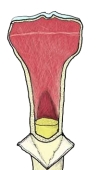 End of a long bone (section)


Related terms
- Epiphysis
- Epiphyseal cartilage
- Periosteum
- Endosteum
- Bone marrow
- Bone matrix
- Cambium layer
- Shaft of humerus
- Shaft of femur
- Proximal epiphysis of humerus
- Articular cartilage
- Nutrient foramen
- Nutrient canal
- Humerus