Ciliary margin of iris (Latin: margo ciliaris iridis)
Also called the root of the iris
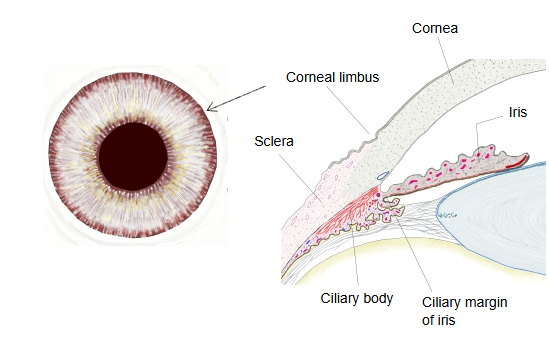
· The ciliary margin is the outer (peripheral) edge of the iris. There the iris is attached to the front of the ciliary body and, through it, to the wall of the iridocorneal angle.
Seen from the front of the eyeball, the ciliary margin lies at about the same place as the corneal limbus, but further back (deeper).
The ciliary margin therefore cannot be seen directly from the front of the eyeball; it is hidden behind the limbus.
· It is the opposite edge to the pupillary margin, which borders the pupil.
· It forms the back wall of the iridocorneal angle, where the iris meets the inner surface of the cornea and sclera; fine strands of the trabecular meshwork link it to the corneoscleral junction.
· The iris is thinnest here, so a blunt injury can tear the iris away from the ciliary body at this edge (iridodialysis).
Reference websites
[Wikipedia]
· Iris (anatomy), Wikipedia.
· Iridodialysis, Wikipedia.
Related terms
- Ciliary crown
- Ciliary ring
- Ciliary folds
- Ciliary processes
- Ciliary zonule
- Circular fibres of ciliary muscle
- Iris
- Ciliary body
- Corneal limbus
- Spaces of iridocorneal angle
- Folds of iris
- Pupil
References and sources
- Further reading: Iris (anatomy), Wikipedia.
- Federative International Programme for Anatomical Terminology (FIPAT). Terminologia Anatomica, 2nd ed. (TA2), 2019.