Intrinsic laryngeal muscles (Latin: musculi laryngis intrinseci)
Also called the intrinsic muscles of the larynx
They are one of the two groups of laryngeal muscles; the other, extrinsic group attaches the larynx to surrounding structures and moves it as a whole.
By moving the arytenoid, thyroid and cricoid cartilages against each other, they open and close the rima glottidis and lengthen, shorten, tense or relax the vocal folds. They therefore control breathing through the larynx, closure of the airway during swallowing, and the pitch and quality of the voice.
One classical anatomy textbook lists the following as the intrinsic laryngeal muscles.
laryngeal
muscles
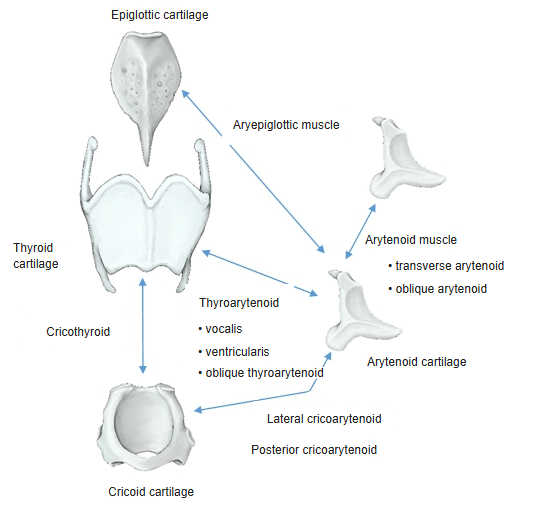
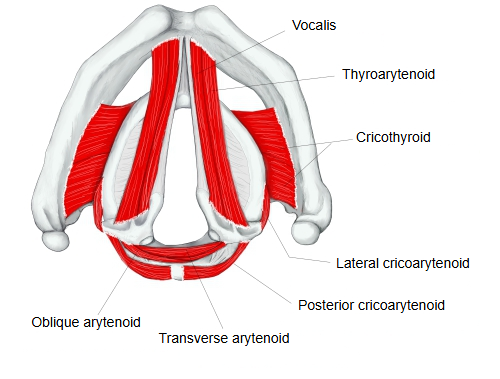
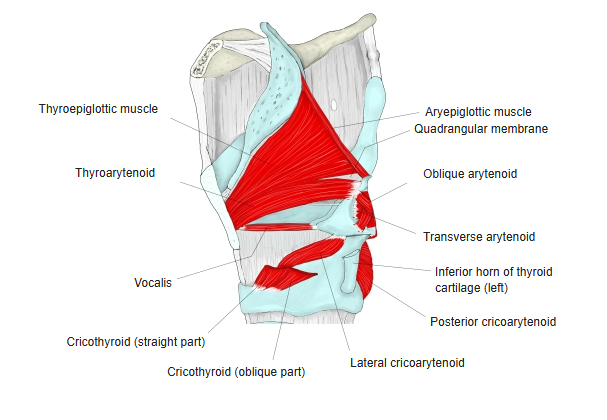
- Cricothyroid : from the outer surface of the arch of the cricoid cartilage to the lower border and inferior horn of the thyroid cartilage. Tilts the thyroid cartilage forwards and tenses the vocal folds.
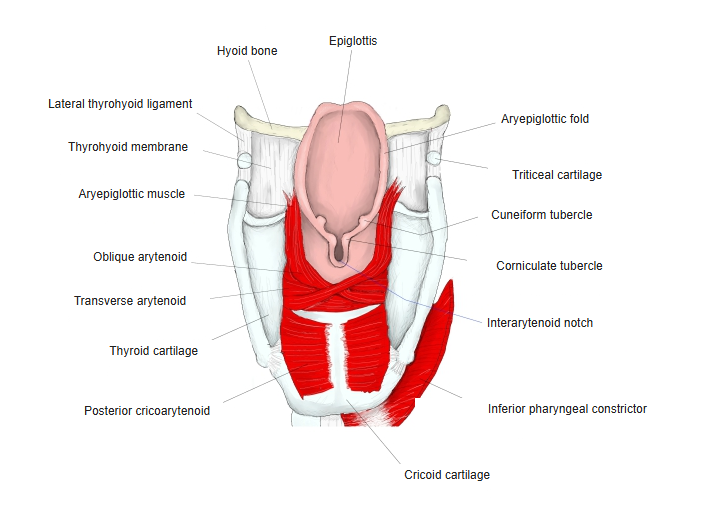
- Posterior cricoarytenoid : from the back of the cricoid lamina to the muscular process of the arytenoid cartilage. The only muscle that opens the rima glottidis.
- Lateral cricoarytenoid : from the upper border and outer surface of the side of the cricoid cartilage to the muscular process and the front of the arytenoid. Closes the rima glottidis.
- Arytenoid : fills the hollow on the backs of the two arytenoid cartilages and ends on their outer borders; two kinds:
- Transverse arytenoid : unpaired; runs horizontally between the outer borders of the two arytenoids and brings them together.
- Oblique arytenoid : from the muscular process of one arytenoid to the apex of the other.
- Aryepiglottic : from the upper outer surface of the arytenoid to the epiglottic cartilage, in the aryepiglottic fold. Usually described as the continuation of the oblique arytenoid (aryepiglottic part).
- (External) thyroarytenoid : from the inner surface of the thyroid cartilage to the muscular process and oblong fovea of the arytenoid. Shortens and relaxes the vocal folds. Fibres running up to the epiglottis form the thyroepiglottic part.
- Thyroarytenoid (inner parts) : inside the laryngeal cavity; two parts:
- Vocalis : from the back of the thyroid cartilage near the midline to the vocal process and oblong fovea; lies beside the vocal ligament.
- Ventricular part : from the back of the thyroid cartilage near the midline to near the colliculus of the arytenoid.
- Oblique thyroarytenoid : from the muscular process of the arytenoid to the upper border of the thyroid cartilage.
Other sources group these muscles differently. Most texts list six main muscles: the cricothyroid, posterior cricoarytenoid, lateral cricoarytenoid, transverse arytenoid, oblique arytenoid and thyroarytenoid; some count the two arytenoids as one muscle, and some name smaller parts (such as the vocalis, aryepiglottic and thyroepiglottic parts) separately.
Nerve supply: all are supplied by the recurrent laryngeal nerve except the cricothyroid, which is supplied by the external branch of the superior laryngeal nerve.
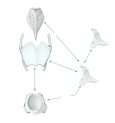 Laryngeal cartilages and muscles
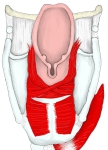 Larynx (posterior)
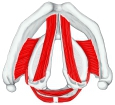 Larynx (superior view)
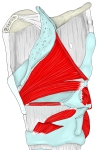 Larynx (lateral view, thyroid lamina removed)
Related terms
- Laryngeal muscles
- Cricothyroid
- Arytenoid cartilage
- Rima glottidis
- Vocal fold
- Recurrent laryngeal nerve
- Larynx
References and sources
- Further reading: Intrinsic muscles of the larynx, Wikipedia.
- Further reading: Larynx, Wikipedia.
- Federative International Programme for Anatomical Terminology (FIPAT). Terminologia Anatomica, 2nd ed. (TA2), 2019.