Aryepiglottic fold (Latin: plica aryepiglottica)
Also called Aryepiglottic folds (plural)
recesses of
the larynx
- Inside the larynx
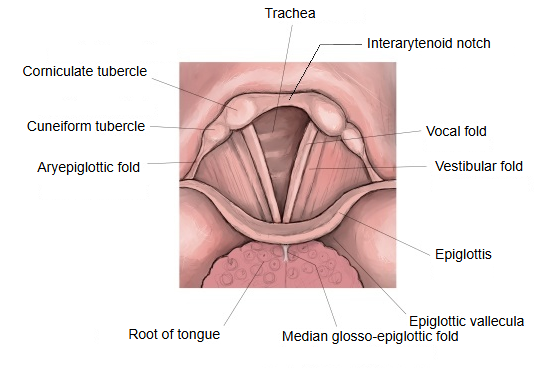
- Vestibular fold : between the thyroid and arytenoid cartilages, over the vestibular ligament and the quadrangular membrane; also called the false vocal cord.
- Vocal fold : between the thyroid and arytenoid cartilages, over the vocal ligament and the conus elasticus; produces the voice.
- At the laryngeal inlet
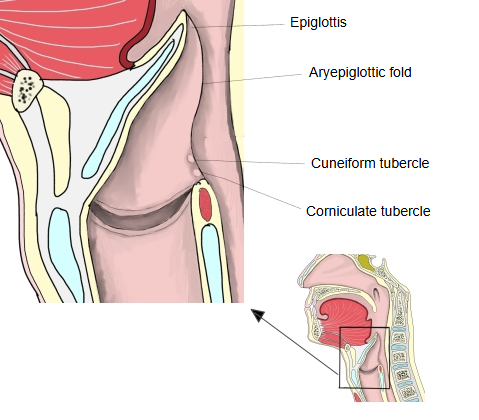
- Aryepiglottic fold : from the epiglottis to the arytenoid cartilage; forms each side of the laryngeal inlet and carries two small tubercles at its back end.
- In front
- Median glosso-epiglottic fold : from the midline of the root of the tongue to the epiglottic cartilage; the only fold that is not paired.
- Lateral glosso-epiglottic fold : on the front of the epiglottis, lateral to the epiglottic vallecula.
- Others
- Fold of superior laryngeal nerve : in the wall of the piriform recess, raised by the superior laryngeal nerve running from upper lateral to lower medial.
- Pharyngo-epiglottic fold : from the side wall of the pharynx to the side of the epiglottic cartilage, at the upper end of the laryngopharynx.
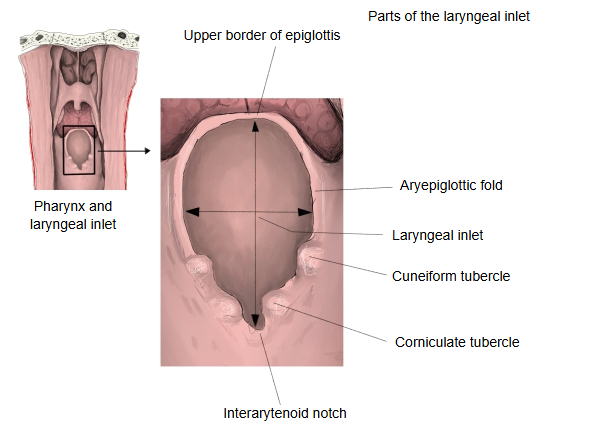
laryngeal inlet
- In front
- Upper border of the epiglottis : the free edge that curves down from the top of the epiglottis.
- At the sides
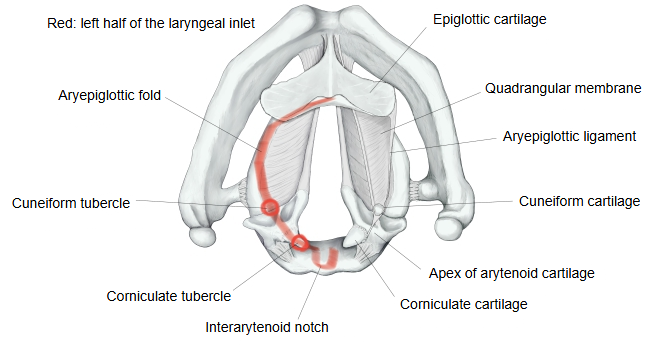
- Aryepiglottic fold : the upper edge of the quadrangular membrane in it forms the aryepiglottic ligament.
- Cuneiform cartilage : its upper part forms the cuneiform tubercle.
- Behind
- Arytenoid cartilage : its upper end, the apex, takes part.
- Corniculate cartilage : its upper part forms the corniculate tubercle.
- Interarytenoid notch : the notch reaching down between the right and left arytenoid apices.
Features of the aryepiglottic fold:
1. It is broader behind than in front.
2. It runs backwards and downwards.
3. Its back end continues into the interarytenoid notch.
· The two folds separate the laryngeal inlet from the piriform recess on each side. Their core is the aryepiglottic ligament and fibres of the aryepiglottic muscle, a continuation of the oblique arytenoid muscle.
· During swallowing the aryepiglottic muscles help draw the folds together and close the inlet. The folds can also vibrate to produce low, rough vocal sounds such as a singer's growl.
· Short or floppy folds are a common cause of laryngomalacia, the most frequent cause of noisy breathing (inspiratory stridor) in infants.
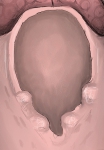 Laryngeal inlet (from behind)
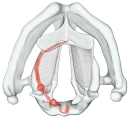 Laryngeal cartilages and the inlet
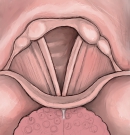 Larynx from above
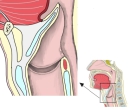 Pharynx and larynx (median section)
Reference websites
[Wikipedia]
· Aryepiglottic fold, Wikipedia.
· Epiglottis, Wikipedia.
[Websites with illustrations]
· Larynx seen from above (illustration) (Oncohema Key)
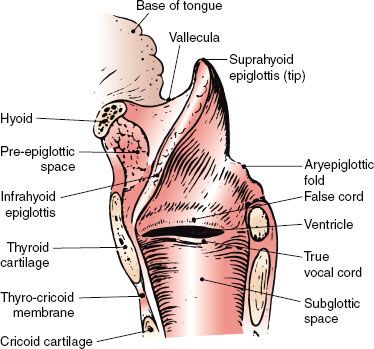
· Laryngeal inlet and folds (illustration) (Ento Key)

· The larynx (TeachMeAnatomy)
Where it is found
Related terms
- Larynx
- Quadrangular membrane
- Cuneiform tubercle
- Corniculate tubercle
- Piriform recess
- Aryepiglottic ligament
- Vestibular fold
References and sources
- Further reading: Aryepiglottic fold, Wikipedia.
- Federative International Programme for Anatomical Terminology (FIPAT). Terminologia Anatomica, 2nd ed. (TA2), 2019.