Triangular ligaments (Latin: ligamenta triangularia hepatis)
Also called the triangular ligaments of liver
For details, see the right triangular ligament and left triangular ligament pages.
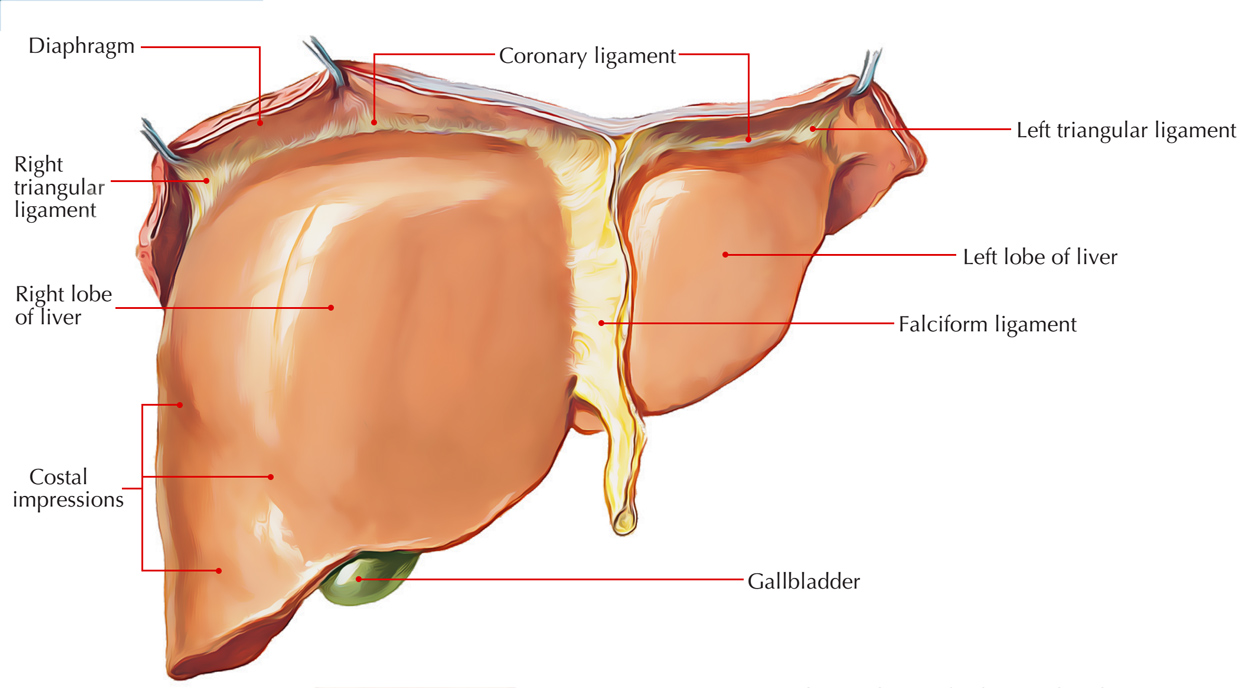
· At each end of the bare area, the upper and lower layers of the coronary ligament come together and fuse into a triangular fold. The right triangular ligament is short and lies at the right tip of the bare area, on the right lobe. The left triangular ligament is longer and attaches the upper surface of the left lobe to the diaphragm; its tip often ends in a fibrous band, the fibrous appendix of liver.
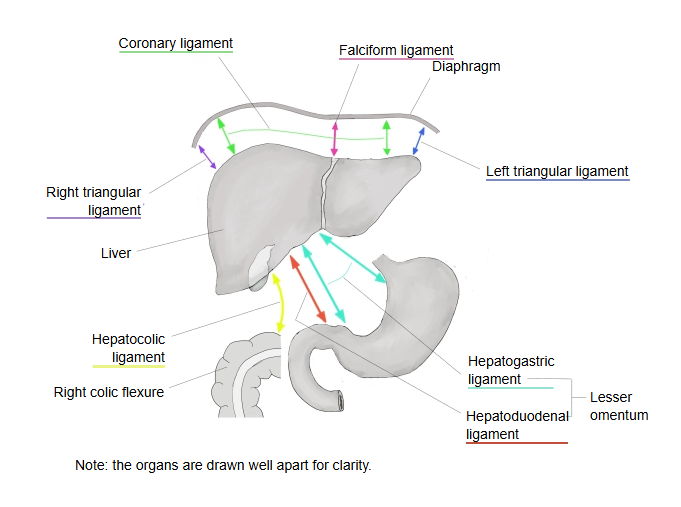
- Falciform ligament : from its attachment on the underside of the diaphragm it runs down the front of the liver to the inferior border, and from there to the umbilicus.
- Coronary ligament : two layers of peritoneum, in front and behind, joining the diaphragmatic surface of the liver to the underside of the diaphragm.
- Left and right triangular ligaments : the left and right ends of the coronary ligament.
- Lesser omentum
- Hepatogastric ligament : joins the liver (at the porta hepatis) to the lesser curvature of the stomach; forms most of the lesser omentum.
- Hepatoduodenal ligament : joins the liver and the duodenum; the thick right edge of the lesser omentum.
Some textbooks also show the hepatocolic ligament as a part of the ventral mesogastrium in their illustrations.
Reference websites
[Wikipedia]
· Triangular ligament of liver, Wikipedia.
· Coronary ligament, Wikipedia.
[Websites with illustrations]
· Liver and its ligaments (Earth's Lab)
· Liver ligaments (illustration) (Science Photo Library)

Related terms
- Right triangular ligament
- Left triangular ligament
- Bare area
- Liver
- Lesser omentum
- Hepatogastric ligament
- Diaphragm
References and sources
- Further reading: Triangular ligament of liver, Wikipedia.
- Further reading: Coronary ligament, Wikipedia.
- Federative International Programme for Anatomical Terminology (FIPAT). Terminologia Anatomica, 2nd ed. (TA2), 2019.