Ventral mesogastrium (Latin: mesogastrium ventrale)
Also called the ventral mesentery of the stomach
meso-
gastrium
- Falciform ligament : attached above to the underside of the diaphragm (and the front abdominal wall); it runs down the front of the liver and on to the umbilicus, carrying the round ligament of liver in its free lower edge
- Coronary ligament : two layers of peritoneum, in front and behind, that join the diaphragmatic surface of the liver to the underside of the diaphragm
- Left and right triangular ligaments : the left and right ends of the coronary ligament
- Lesser omentum
- Hepatogastric ligament : joins the liver (at the porta hepatis) to the stomach (lesser curvature); the larger part of the lesser omentum
- Hepatoduodenal ligament : joins the liver to the duodenum; the thick right end of the lesser omentum
Some texts use the term for the adult folds listed above, and some illustrations also show a hepatocolic ligament as part of it. Parts of the whole peritoneum: see Peritoneum.
The stomach, too, has a mesentery, the mesogastrium. It is divided into the ventral mesogastrium, which joins the stomach to the front body wall, and the dorsal mesogastrium, which joins it to the back wall and later forms the greater omentum. The liver grows into the ventral mesogastrium and divides it into a part between the liver and the stomach (the lesser omentum) and a part between the liver and the front body wall and diaphragm (the falciform, coronary and triangular ligaments). The name is mainly used in embryology; in the adult the same peritoneum is described as separate ligaments.
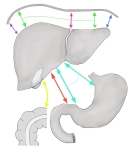 Ventral mesogastrium (schematic)
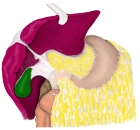 Greater omentum and lesser omentum
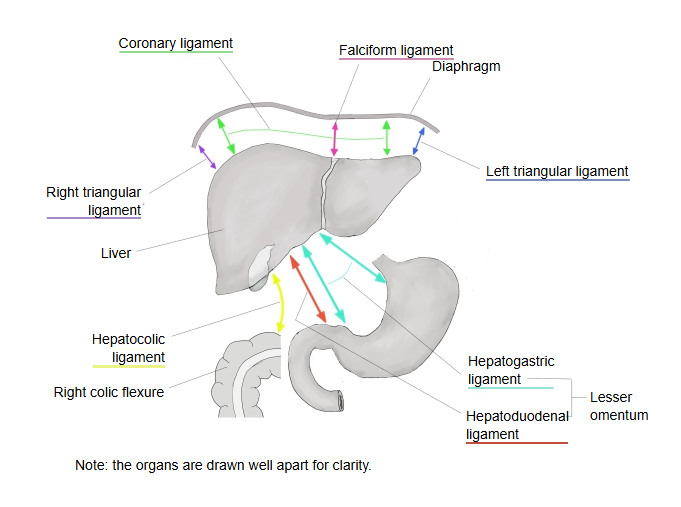
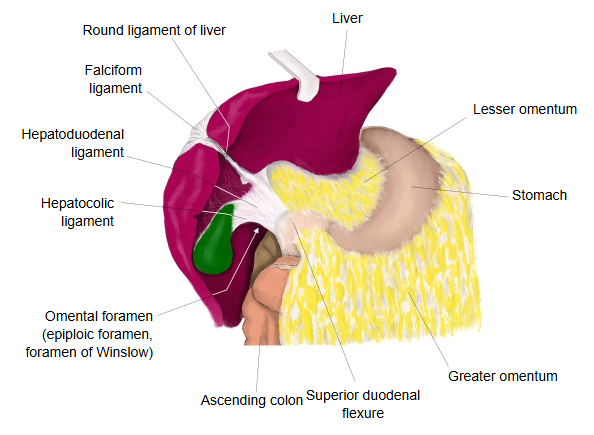
Related terms
- Lesser omentum
- Hepatogastric ligament
- Hepatoduodenal ligament
- Triangular ligaments
- Round ligament of liver
- Omentum
- Peritoneum
References and sources
- Further reading: Ventral mesentery, Wikipedia.
- Further reading: Lesser omentum, Wikipedia.
- Federative International Programme for Anatomical Terminology (FIPAT). Terminologia Anatomica, 2nd ed. (TA2), 2019.