Anterior alveolar canal
Also called the anterior superior alveolar canal
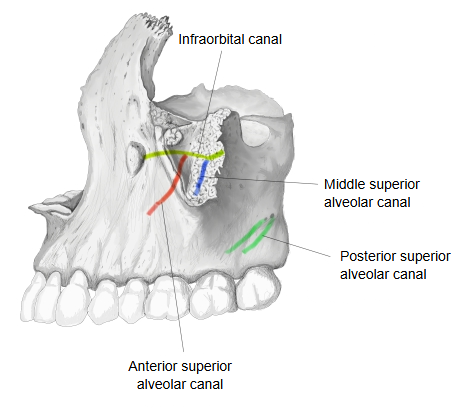
The anterior (superior) alveolar canal is one of the three alveolar canals of the maxilla, and the longest of them: a bony canal that carries nerves and vessels.
Alveolar canals: anterior, middle and posterior superior alveolar canalsNerves and vessels: for the upper teeth, the gums, the tooth sockets and the maxillary sinusLongest: about 55 mm (rough estimate)
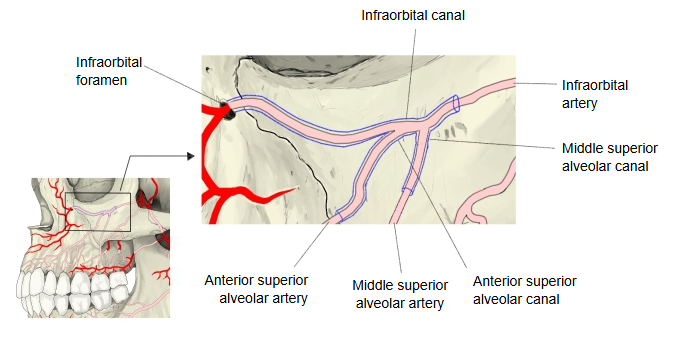
It branches from the infraorbital canal in the floor of the orbit, runs down in the front wall of the maxillary sinus and leads nerves and vessels to the incisors and the canine.
Infraorbital canal: the continuation of the infraorbital grooveNerves and vessels: the anterior superior alveolar nerve, artery and vein
Alveolar
canals
canals
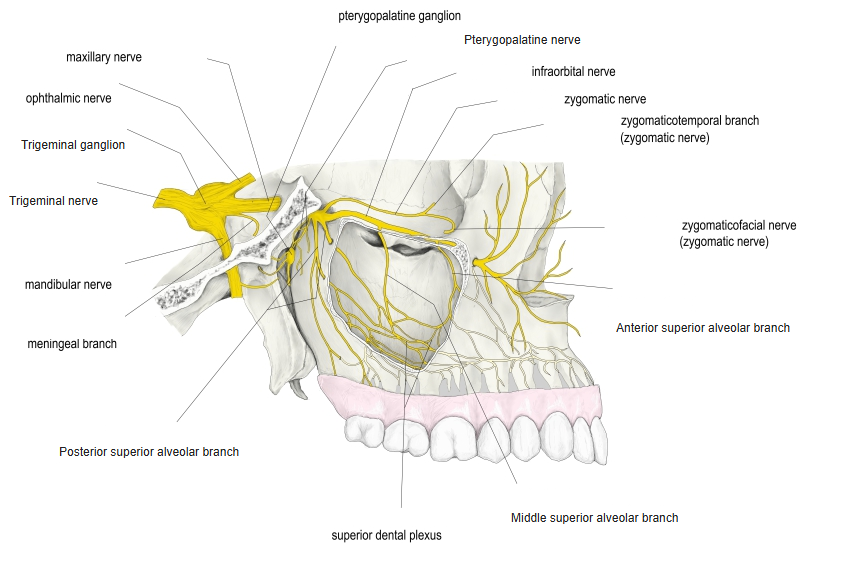
- Anterior superior alveolar canal : branches from the infraorbital canal (the continuation of the infraorbital groove) and runs in the front wall of the body of the maxilla. Contents: anterior superior alveolar nerve, artery and vein. Length: about 55 mm (estimate).
- Middle superior alveolar canal : branches from the infraorbital canal and seems to run down about where the front and back walls of the body of the maxilla meet; much about it is unclear, and it is not always present. Contents: the middle superior alveolar nerve and the middle superior alveolar artery and vein. Length: about 33-35 mm (estimate).
- Posterior superior alveolar canal : begins at the alveolar foramina (2-3) on the maxillary tuberosity. Contents: the posterior superior alveolar branches of the maxillary nerve and the posterior superior alveolar artery and vein. Length: about 44-50 mm (estimate).
Note: in English Wikipedia the term 'alveolar canals' refers only to the posterior canals. The lengths above are rough estimates and may not be accurate.
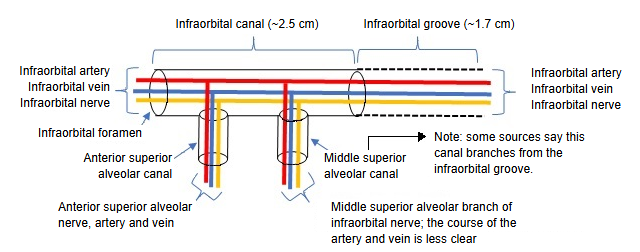
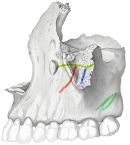 Alveolar canals of the maxilla
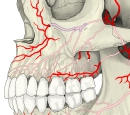 Canals and arteries
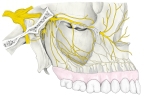 Maxillary nerve