Internal aperture of vestibular aqueduct
Also called Internal opening of vestibular aqueduct
The name is used in contrast to the external aperture of the vestibular aqueduct, but it does not seem to be a widely used name.
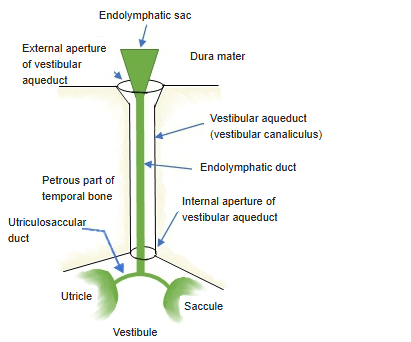
The vestibular aqueduct (or vestibular canaliculus), which carries the endolymphatic duct, has two openings. The internal aperture is the one in the vestibule; the opening on the posterior surface of the petrous part, facing the cranial cavity, is the external aperture. Because the cranial end is the more medial of the two, the names can seem the wrong way round: here ‘internal’ means the end inside the inner ear.
It is a small hole at the back of the medial wall of the bony vestibule, below the elliptical recess and near the openings of the semicircular canals. The endolymphatic duct, formed from the saccule and utricle, enters the aqueduct here; from this opening the aqueduct runs backwards through the petrous part to its external aperture, where the duct ends in the endolymphatic sac.
Older texts call this internal aperture the vestibular opening of the vestibular canaliculus.
Related terms
- Vestibular aqueduct
- External aperture of vestibular aqueduct
- Vestibular ganglion
- Pyramid of vestibule
- Vestibular crest
- Scala vestibuli
- Endolymphatic duct
- Endolymphatic sac
- Vestibule
- Elliptical recess
- Petrous part
- Internal aperture of cochlear canaliculus
References and sources
- Further reading: Vestibular aqueduct, Wikipedia.
- Federative International Programme for Anatomical Terminology (FIPAT). Terminologia Anatomica, 2nd ed. (TA2), 2019.