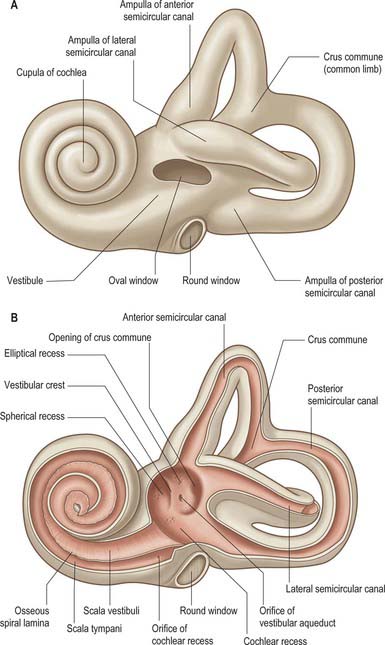
Vestibular crest (Latin: crista vestibuli)
of the
medial wall
of the
vestibule
- Elliptical recess : a large, rounded recess that holds the utricle; the utriculo-ampullary nerve passes through the superior cribriform area here
- Spherical recess : the recess that holds the saccule; the saccular nerve passes through the middle cribriform area here. The vestibular crest separates it from the elliptical recess.
- Cochlear recess : a small depression between the two lower limbs of the vestibular crest that holds the vestibular (lower) end of the cochlear duct; its small holes carry nerve fibres to that end of the duct
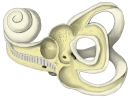 Left bony labyrinth, opened from the lateral side
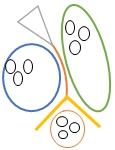 Cribriform areas, recesses and vestibular crest (model)
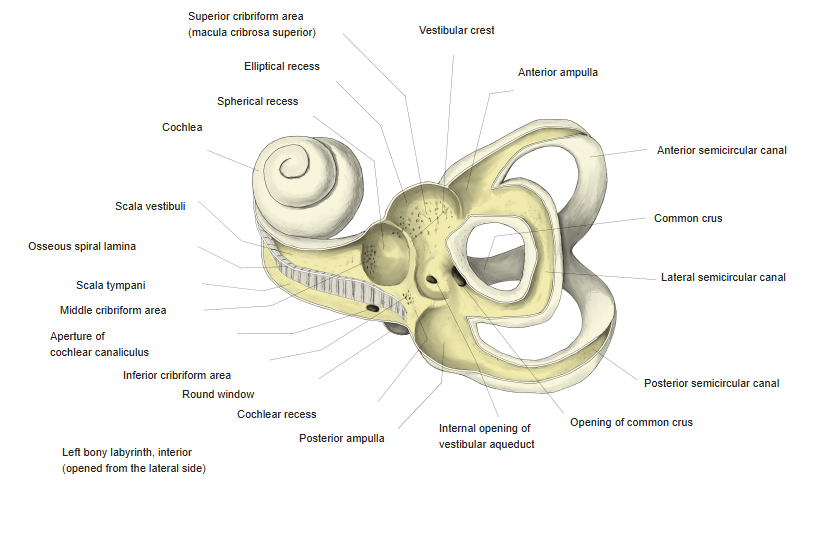
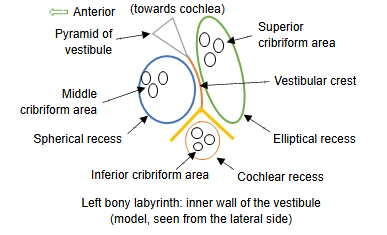
The vestibular crest is an oblique ridge between the spherical recess in front and the elliptical recess behind; its upper (front) end is the pyramid of the vestibule. Below, it splits to enclose the small cochlear recess, which is perforated by holes for nerve fibres that supply the vestibular end of the cochlear duct. Other small groups of holes nearby (the cribriform areas) let nerve fibres from the internal acoustic meatus reach the utricle, saccule and ampullae; the posterior ampullary nerve passes through the inferior cribriform area to the ampulla of the posterior semicircular canal.
Reference websites
[Wikipedia]
· Bony labyrinth, Wikipedia.
[Websites with illustrations]
· Interior of the right osseous labyrinth (Gray's Anatomy) (Wikimedia Commons)

· Bony labyrinth, closed and opened, with the vestibular crest and recesses (Clinical Gate)
· Bony labyrinth, right side, partly opened (Muhadharaty)

Related terms
- Vestibular aqueduct
- External aperture of vestibular aqueduct
- Internal aperture of vestibular aqueduct
- Vestibular ganglion
- Pyramid of vestibule
- Scala vestibuli
- Vestibule
- Spherical recess
- Elliptical recess
- Cochlear recess
- Inferior cribriform area
- Bony labyrinth
- Cochlear duct
References and sources
- Further reading: Bony labyrinth, Wikipedia.
- Federative International Programme for Anatomical Terminology (FIPAT). Terminologia Anatomica, 2nd ed. (TA2), 2019.