Visual axis (Latin: linea visus)
Also called the line of vision
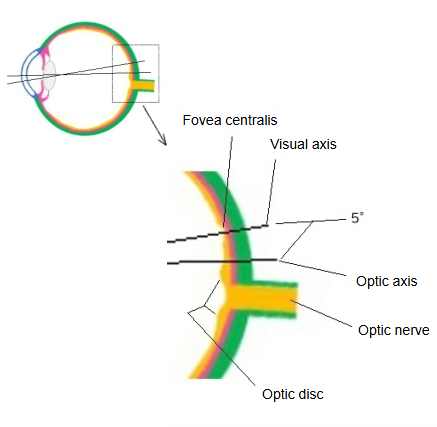
The visual axis is the straight line joining the cornea → lens → fovea centralis: the line along which an object is seen most clearly.
It crosses the optic axis of the eyeball at an angle of about 5°
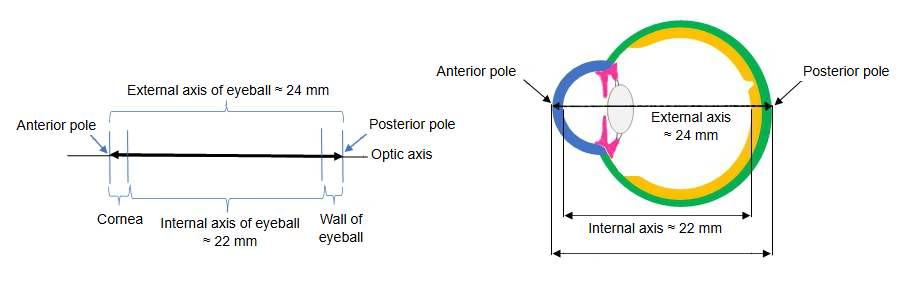
An object is seen most clearly along this line because its image falls on the fovea centralis in the centre of the macula lutea, the spot of sharpest vision. The fovea lies slightly lateral to (on the temporal side of) the posterior pole, so the visual axis is not the same line as the optic axis through the two poles of the eyeball; the two axes cross near the lens at an angle of about 5 degrees. Sources differ: some texts define the visual axis through the nodal points of the eye, and others use "line of sight" for a slightly different line through the centre of the pupil.
Related terms
- Optic axis
- External axis of eyeball
- Internal axis of eyeball
- Posterior pole of eyeball
- Eyeball
- Macula lutea
- Lens
References and sources
- Further reading: Visual axis, Wikipedia.
- Further reading: Fovea centralis, Wikipedia.
- Federative International Programme for Anatomical Terminology (FIPAT). Terminologia Anatomica, 2nd ed. (TA2), 2019.