Dental alveoli (Latin: alveoli dentales)
Singular: dental alveolus; also called tooth sockets
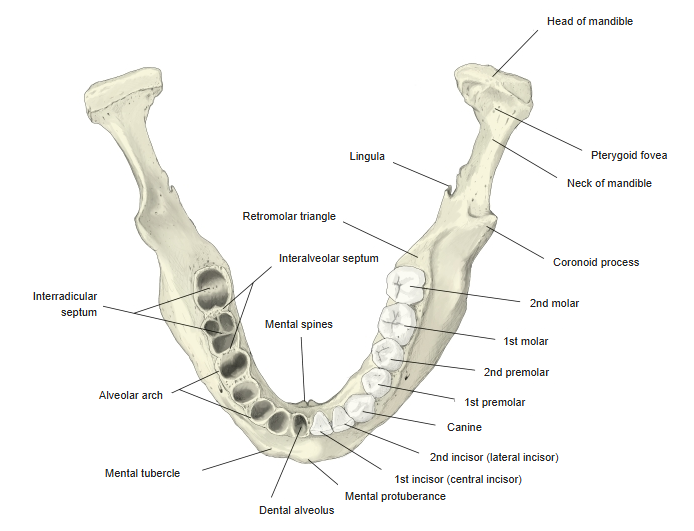
The dental alveoli are the openings in the maxilla and the mandible into which the roots of the teeth fit. Number: 14-16 in each jaw.
Maxilla and mandible: bones of the facial skeletonIn the adult: 16 per jaw, eight on each side, one for each permanent tooth (14 when the third molars are missing); 10 per jaw in the primary dentition
In the maxilla the dental alveoli lie in the alveolar process, and in the mandible in the alveolar part.
Neighbouring sockets are separated by interalveolar septa; the sockets of multirooted teeth are divided by interradicular septa. The thin bone lining the socket is the alveolar bone proper (part of the alveolar bone); the sockets together form the alveolar arch of each jaw.
Each root is held in its socket by the periodontal ligament. This fibrous joint between tooth and socket is a gomphosis. When a tooth is lost, its socket fills with bone and the alveolar ridge is gradually resorbed.
Reference websites
[Wikipedia]
· Dental alveolus, Wikipedia.
[Websites with illustrations]
· Tooth sockets (figure) (Springer Nature)

· Skull illustration (dental alveoli) (IMAIOS e-Anatomy)
Related terms
- Alveolar border
- Alveolar canals
- Alveolar arch
- Alveolar foramina
- Alveolar bone
- Alveolar yokes
- Alveolar crest
- Gingival sulcus
- Apical foramen
- Alveolar process
- Interradicular septa
- Periodontal ligament
- Root of tooth
- Teeth
- Maxilla
- Mandible
References and sources
- Further reading: Dental alveolus, Wikipedia.
- Federative International Programme for Anatomical Terminology (FIPAT). Terminologia Anatomica, 2nd ed. (TA2), 2019.