Radii of lens (Latin: radii lentis)
Also called: lens sutures; lens stars (stellae lentis)
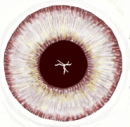
On the front and back surfaces of a fixed lens of a newborn there is a star made of three rays, the anterior and posterior lens stars; the three rays of each star are set at 120° to each other (the Y sutures). The vertical ray of the anterior star points upwards and that of the posterior star downwards, so the two stars face in opposite directions. In the adult the simple three-rayed star remains only in the lens nucleus; new rays appear in the outer layers, so the surface of the lens shows complex lens stars of six or more rays.
The lens substance separates easily into the softer cortex and the firmer nucleus; in the fetus, if the lens capsule is cut, the lens splits open along the sutures. In the living eye a few radii can just be seen running out from the anterior and posterior poles. Sources differ on whether the anterior Y of the fetal lens is called upright or inverted; the two stars always point in opposite directions.
The stars (stellae lentis anterior and posterior) are seen best on a fixed or macerated lens; their rays are the radii of the lens stars (radii stellarum lentis). In the outer layers further rays are usually present, so that the stars have six or nine rays. The stars appear because the ends of many lens fibers meet and abut along seam lines (sutures), which are visible to the naked eye: no lens fiber runs all the way from one pole to the other. The sutures can also be seen with a slit lamp, and some congenital cataracts follow their Y shape.
Reference websites
[Wikipedia]
· Lens (vertebrate anatomy), Wikipedia.
Related terms
- Lens nucleus
- Lens cortex
- Posterior pole of lens
- Axis of lens
- Equator of lens
- Lens
- Eyeball
- Ciliary zonule
- Anterior chamber of eyeball
References and sources
- Further reading: Lens (vertebrate anatomy), Wikipedia.
- Federative International Programme for Anatomical Terminology (FIPAT). Terminologia Anatomica, 2nd ed. (TA2), 2019.