Metacarpal muscles
Also called the central (intermediate) group of hand muscles
The metacarpal muscles
· The name is a descriptive grouping, not a formal anatomical term; many textbooks simply call this the central or intermediate group of the hand muscles.
muscles
of the
hand
- Thenar muscles : abductor pollicis brevis, flexor pollicis brevis, opponens pollicis, adductor pollicis
- Hypothenar muscles : abductor digiti minimi, flexor digiti minimi brevis, opponens digiti minimi, palmaris brevis
- Metacarpal muscles : lumbricals, (dorsal and palmar) interossei
Metacarpal muscles
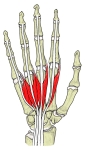 Lumbricals
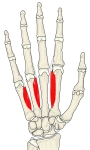 Palmar interossei
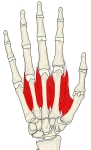 Dorsal interossei
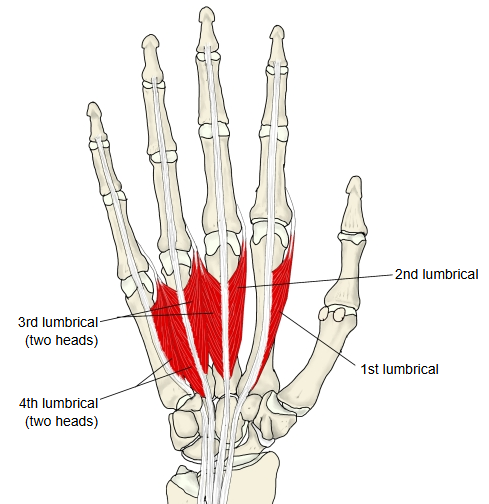
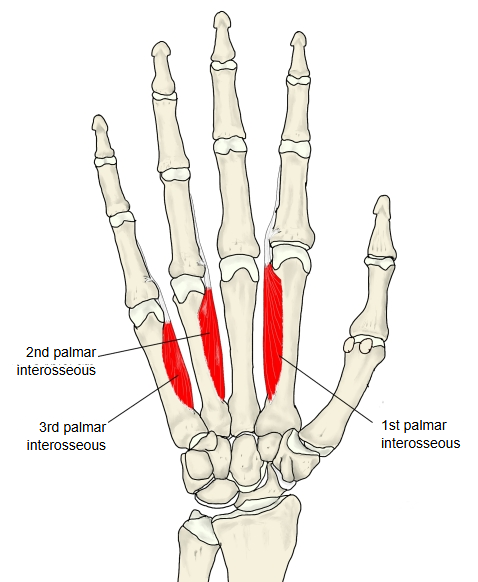
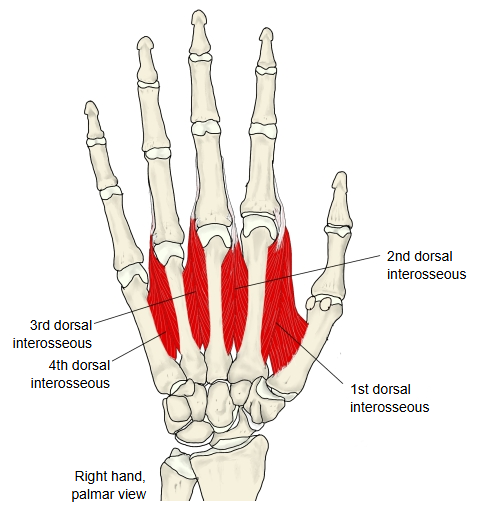
They lie in the middle of the palm, in and between the spaces of the metacarpal bones, between the thenar muscles of the thumb and the hypothenar muscles of the little finger.
· Lumbricals (4): arise from the tendons of flexor digitorum profundus; they flex the metacarpophalangeal joints and extend the interphalangeal joints.
· Palmar interossei (3, sometimes counted as 4): adduct the fingers towards the middle finger.
· Dorsal interossei (4): two-headed muscles between the metacarpals; they abduct the fingers away from the middle finger.
All are supplied by the deep branch of the ulnar nerve, except the 1st and 2nd lumbricals, which are supplied by the median nerve.
Related terms
- Intrinsic muscles of hand
- Lumbricals (hand)
- Dorsal interossei (hand)
- Thenar muscles
- Hypothenar muscles
- Palm of hand
- Metacarpal bones
References and sources
- Further reading: Intrinsic muscles of the hand, Wikipedia.
- Further reading: Lumbricals of the hand, Wikipedia.
- Federative International Programme for Anatomical Terminology (FIPAT). Terminologia Anatomica, 2nd ed. (TA2), 2019.