Bones of hand (Latin: ossa manus)
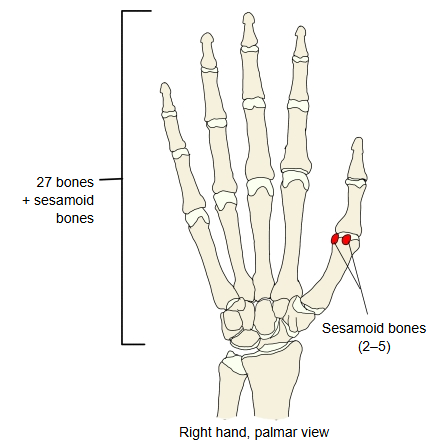
The bones of the hand are the bones of the part of the upper limb beyond the wrist, the part we use to grasp things.
Each hand has 27 bones + sesamoid bones.
Sesamoid bones: 2 to 5 small bones, not counting the pisiform
More details
The 27 bones are made up as follows.
| 1 | Carpal bones | Small bones at the wrist | 8 | 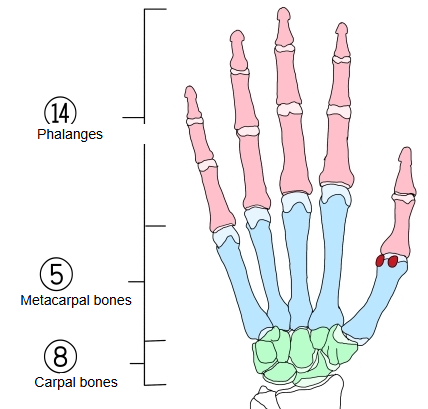 |
| 2 | Metacarpal bones | Long bones of the palm, below the fingers | 5 | |
| 3 | Phalanges | The bones of the fingers | 14 |
From proximal to distal: the eight short carpal bones lie in two rows of four and form the wrist and the heel of the hand; the five metacarpal bones, numbered I (thumb) to V (little finger), form the palm; the phalanges form the fingers, with proximal, middle and distal phalanges in each finger but only proximal and distal phalanges in the thumb. The usual count of 27 leaves out the sesamoid bones: two at the thumb are almost always present, while others vary. The pisiform is a sesamoid bone in origin but is counted as a carpal bone.
Related terms
- Carpal bones
- Metacarpal bones
- Phalanges
- Sesamoid bone
- Bones of upper limb
- Bones of free part of upper limb
- Palm of hand
References and sources
- Further reading: Hand, Wikipedia.
- Further reading: Carpal bones, Wikipedia.
- Federative International Programme for Anatomical Terminology (FIPAT). Terminologia Anatomica, 2nd ed. (TA2), 2019.