Sesamoid bone (Latin: os sesamoideum)
classified
by shape
- Long bone : long and tube-like, whatever its size: the femur, the humerus and others. Also called tubular bone.
- Short bone : length and width about the same: the carpal bones and the tarsal bones.
- Flat bone : flat, plate-like bones: the bones of the cranial vault, the sternum and others.
- Irregular bone : bones of irregular shape: the vertebrae and many bones of the facial skeleton.
- Pneumatic bone : bones with air-filled spaces: the frontal bone, the sphenoid and others.
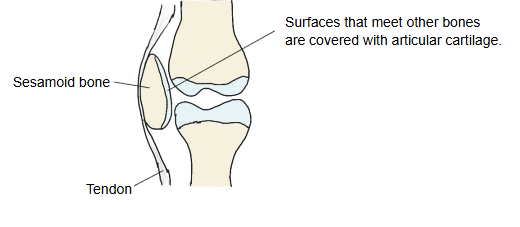
- Sesamoid bone : bones that develop in a tendon of the hand or foot, or in the joint capsule that blends with it.
A sesamoid bone is a small piece of bone that forms in a tendon, or in the joint capsule that the tendon blends with, where the tendon passes over a bony prominence or a joint and moves back and forth over it. It glides on the bone beneath it and forms a small joint with it; the contact surface is covered with articular cartilage. It protects the tendon from friction and wear and changes the angle of pull of the tendon, giving the muscle better leverage. The degree of ossification varies, and some stay largely fibrocartilage. Most are found in the tendons of the hand and foot, such as those at the metacarpophalangeal joint of the thumb; the patella, the largest sesamoid bone of the body, and the pisiform also belong to this group.
Where they occur
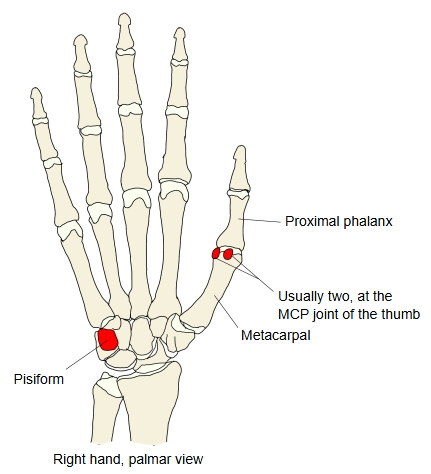
| Upper limb | Hand | The pisiform, in the tendon of flexor carpi ulnaris (it forms the pisiform joint with the triquetrum), and usually two small bones on the palmar side of the metacarpophalangeal joint of the thumb, between the first metacarpal and the proximal phalanx. Smaller ones are sometimes found at other metacarpophalangeal joints and at the interphalangeal joint of the thumb. |
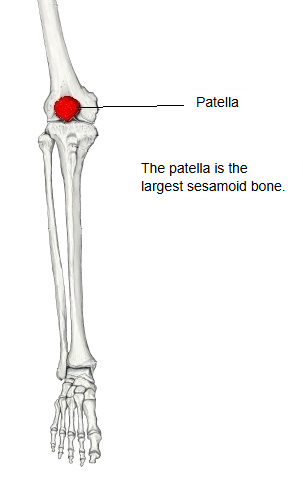
| Lower limb | Knee | The patella, the largest sesamoid bone, in the tendon of quadriceps femoris in front of the knee joint. A small fabella is sometimes present in the lateral head of gastrocnemius. |
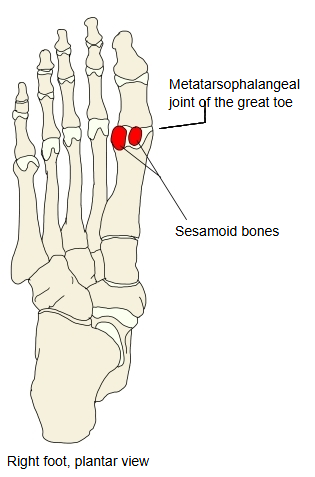
| Foot | Usually two under the head of the first metatarsal, at the metatarsophalangeal joint of the great toe, in the tendons of flexor hallucis brevis. | |
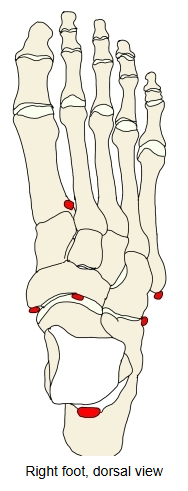
| Others appear variably around the tarsal bones, sometimes in large numbers, for example in the tendon of fibularis longus next to the cuboid. |
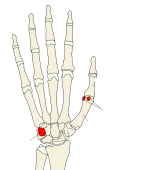 Right hand (palmar)
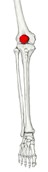 Right lower limb (anterior)
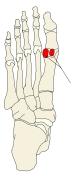 Right foot (plantar)
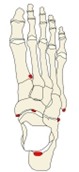 Right foot (dorsal)
Summary
Reference websites
[Wikipedia]
· Sesamoid bone, Wikipedia.
· Bone: classification by shape, Wikipedia.
[Websites with illustrations]
· Sesamoid bones of the fingers (X-ray diagram) (Wikimedia Commons)

· Accessory and sesamoid bones of the foot (dorsoplantar projection) (Wikimedia Commons)

· Bones of the left hand, palmar surface (Gray's Anatomy, fig. 219) (Wikimedia Commons)

Where it is found
Related terms
- Patella
- Pisiform
- Pisiform joint
- First metacarpal
- Carpal bones
References and sources
- Further reading: Sesamoid bone, Wikipedia.
- Federative International Programme for Anatomical Terminology (FIPAT). Terminologia Anatomica, 2nd ed. (TA2), 2019.