Vertebral arch (Latin: arcus vertebrae)
Also called the neural arch
The vertebral arch is the arch-shaped part of a vertebra that projects backwards from the vertebral body. It is divided into the laminae and the pedicles, and three kinds of processes arise from it: the spinous, articular and transverse processes.
Arch-shaped part: together with the body it encloses the vertebral foramenVertebra: one of the bones of the vertebral columnVertebral body: the thick, roughly cylindrical front part of a vertebra
Vertebra
- Vertebral body : the front part; it bears the weight.
- Vertebral arch
- Pedicle : short, thick bar joining the arch to the body; its borders carry the superior and inferior vertebral notches, which form the intervertebral foramina with the neighbouring vertebrae.
- Lamina : flat plate running back from the pedicle; the right and left laminae meet in the midline.
- Processes : spinous process, superior and inferior articular processes, transverse processes.
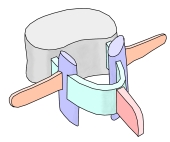 Parts of a vertebra (schematic)
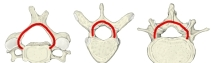 Vertebral arches at three levels
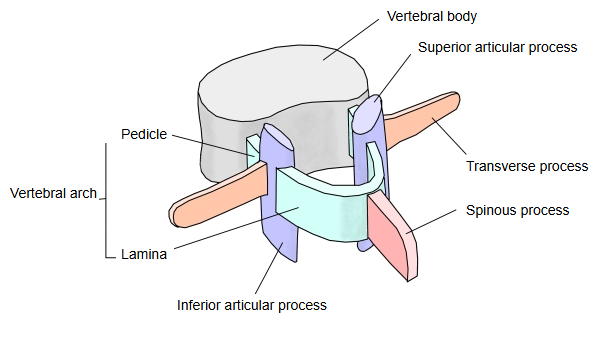
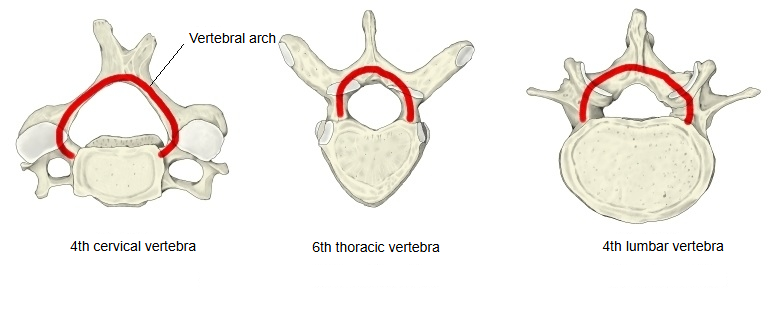
In more detail:
The vertebral arch projects backwards from the body of the vertebra and closes the vertebral foramen behind. It consists of a pair of pedicles and a pair of laminae, and seven processes arise from it: one spinous process, two transverse processes, two superior articular processes and two inferior articular processes. Stacked one above another and joined by the ligamenta flava, the arches form the back wall of the vertebral canal, which protects the spinal cord.
Related terms
- Vertebral foramen
- Vertebra
- Pedicle of vertebral arch
- Lamina of vertebral arch
- Vertebral body
- Spinous process
- Transverse process
- Superior articular process
- Inferior articular process
- Vertebral canal
- Ligamenta flava
References and sources
- Further reading: Vertebra, Wikipedia.
- Further reading: Vertebral arch, Wikipedia.
- Federative International Programme for Anatomical Terminology (FIPAT). Terminologia Anatomica, 2nd ed. (TA2), 2019.