Smooth muscle (Latin: textus muscularis levis)
Also called the smooth muscle tissue or the non-striated muscle
The muscle that forms the walls of the internal organs other than the heart (the stomach, the intestines, blood vessels and others): the visceral muscle. It is involuntary muscle without cross-striations.
- Skeletal muscle : striated muscle and voluntary muscle
- Smooth muscle : visceral muscle and involuntary muscle
- Cardiac muscle : striated muscle, but involuntary
[More detail] Unlike striated muscle, its actin and myosin are not arranged in a regular pattern, so it shows no striations. It cannot be moved at will (involuntary muscle); its activity is controlled by the autonomic nervous system, various hormones and local signals, and many smooth muscles also contract on their own.
The fibres (cells) of smooth muscle are spindle-shaped, usually up to about 0.2 mm long (longer in the pregnant uterus), and each contains one central nucleus. They have few mitochondria and no sarcomeres.
· Smooth muscle is found in the digestive tract, the airways, the blood vessels, the urinary and reproductive tracts, the eye (iris and ciliary muscle) and the skin (arrector pili muscles).
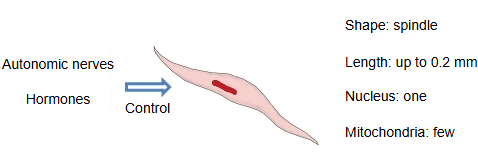
⇒ Site with a cross-section illustration

| Skeletal muscle (striated) | Smooth muscle | Cardiac muscle (striated) | ||
| 1 | Motor end plate | present | absent | absent |
| 2 | Fibres | cylindrical, long (up to about 15 cm) | spindle-shaped, short (up to about 0.2 mm) | branched |
| 3 | Mitochondria | moderate to many (most in red, slow fibres) | few | very many |
| 4 | Nuclei per fibre | many | 1 | 1 |
| 5 | Sarcomeres | present, length up to 3.65 µm | absent | present, length up to 2.6 µm |
Related terms
- Striated muscle
- Alveolar septum
- Basement membrane
- Visceral muscle
- Involuntary muscle
- Muscle
- List of Smooth Muscles
- Trachealis
- Stomach
- Urinary bladder
References and sources
- Further reading: Smooth muscle, Wikipedia.
- Federative International Programme for Anatomical Terminology (FIPAT). Terminologia Anatomica, 2nd ed. (TA2), 2019.