Synchondrosis (Latin: synchondrosis)
Also called the hyaline cartilage joint or the primary cartilaginous joint
- Hyaline cartilage joint : = synchondrosis. The bones are joined by hyaline cartilage, which tends to turn to bone with age. Examples: the epiphyseal cartilages, the joint of the first costal cartilage with the sternum (sternal synchondroses), and the sphenooccipital synchondrosis.
- Fibrocartilage joint : = symphysis. The bones are joined by fibrocartilage. Examples: the pubic symphysis, the intervertebral joints and the manubriosternal joint.
Joints are commonly classified as shown below. In this scheme the hyaline cartilage joint is one of the "cartilaginous joints" among the joints without a joint cavity (fixed or slightly movable joints); the hyaline cartilage joint itself allows little or no movement.
of joints
- Joints without a joint cavity (fixed or slightly movable)
- a. Fibrous joints : syndesmosis, suture, gomphosis.
- b. Cartilaginous joints : fibrocartilage joint (symphysis; slightly movable), hyaline cartilage joint (synchondrosis).
- c. Synostosis : bones fused by bone.
- Movable joints : there is a space (the joint cavity) between the bones, which are completely separate: the "joints in the narrow sense" (synovial joints).
When a text speaks of a cartilaginous joint without saying which kind, it usually means a hyaline cartilage joint.
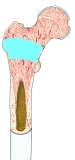 Epiphyseal plate of the femur
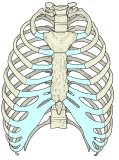 Costal cartilages
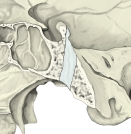 Sphenooccipital synchondrosis
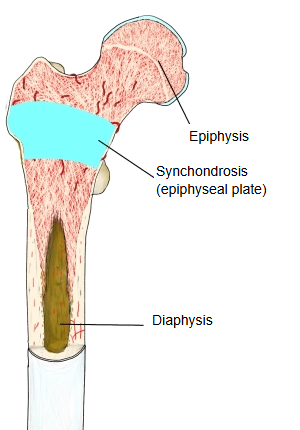
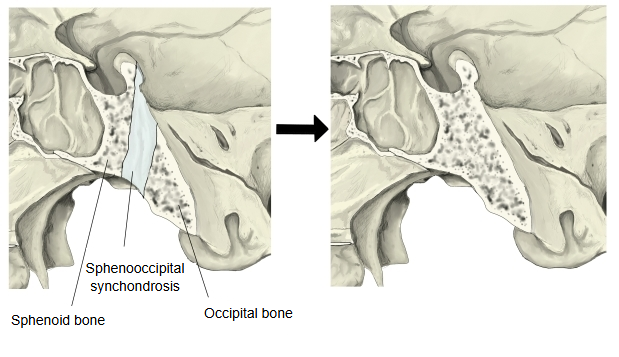
A hyaline cartilage joint joins bones by hyaline cartilage and is a kind of fixed joint. Examples: (1) the joint between the first rib and the manubrium of the sternum (through the first costal cartilage), which ossifies in adulthood and becomes a bony union; (2) the epiphyseal plate (epiphyseal cartilage), the plate of hyaline cartilage that joins the epiphysis and the diaphysis of a growing bone and turns to bone when growth stops; (3) the sphenooccipital synchondrosis, which joins the sphenoid bone and the occipital bone and is usually said to ossify after puberty. Sources differ on the age at which each synchondrosis closes.
Question
Websites that explain the hyaline cartilage joint often name only the sphenooccipital synchondrosis as an example and not the other cranial synchondroses. This does not mean the others are a different kind of joint: the cranial synchondroses (sphenooccipital, sphenopetrosal, petro-occipital, intra-occipital and others) are all hyaline cartilage joints; the sphenooccipital synchondrosis is simply the largest and best-known of them.
Related terms
- Hyaline cartilage
- Cartilaginous joint
- Symphysis
- Epiphyseal cartilage plate
- Sternal synchondroses
- Cranial synchondroses
- Sphenooccipital synchondrosis
- Costal cartilage
References and sources
- Further reading: Synchondrosis, Wikipedia.
- Further reading: Cartilaginous joint, Wikipedia.
- Federative International Programme for Anatomical Terminology (FIPAT). Terminologia Anatomica, 2nd ed. (TA2), 2019.